
Overview
A Trip to the Moon (French: Le Voyage dans la Lune [lə vwajaʒ dɑ̃ la lyn], transl. "The Journey into the Moon") is a 1902 French science-fiction adventure trick film written, directed and produced by Georges Méliès. Inspired by the Jules Verne novel From the Earth to the Moon (1865) and its sequel Around the Moon (1870), the film follows a group of astronomers who travel to the Moon in a cannon-propelled capsule, explore the Moon's surface, escape from an underground group of Selenites (lunar inhabitants), and return to Earth with a captive Selenite. Méliès leads an ensemble cast of French theatrical performers as the main character Professor Barbenfouillis. Although the film disappeared into obscurity after Méliès's retirement from the film industry, it was rediscovered around 1930, when Méliès's importance to the history of cinema was beginning to be recognised by film devotees. An original hand-coloured print was discovered in 1993, and restored in 2011. A Trip to the Moon was ranked 84th among the 100 greatest films of the 20th century by The Village Voice. The film remains Méliès' best-known, and the moment when the capsule lands (in the moon's eye) remains one of the most iconic, and frequently referenced, images in the history of cinema.
From Wikipedia contributors · CC BY-SACast and characters
- Georges Méliès
- Professor Barbenfouillis and The Moon
- Bleuette Bernon
- Phoebe
- François Lallement
- the officer of the marines
- Acrobats of the Folies Bergère
- Selenites
Behind the film
Storyline (spoilers)
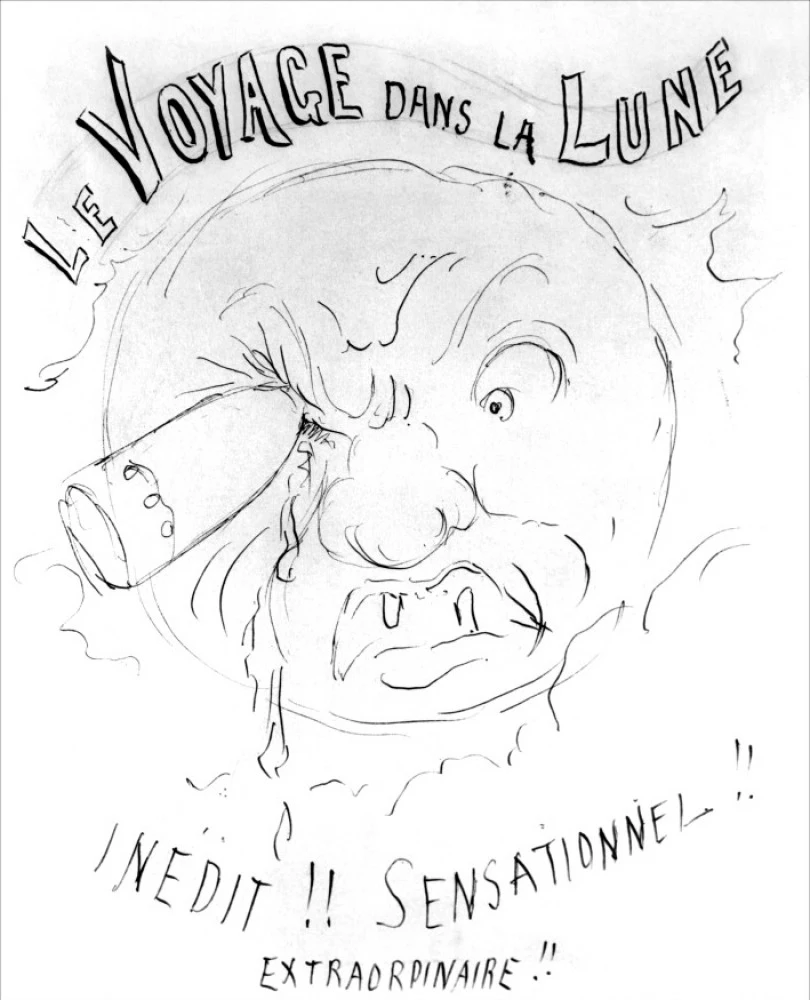
At a meeting of the Astronomy Club, its president, Professor Barbenfouillis, proposes an expedition to the Moon. After addressing some dissent, five other brave astronomers—Nostradamus, Alcofrisbas, Omega, Micromegas, and Parafaragaramus—agree to the plan. A space capsule in the shape of a bullet is built, along with a huge cannon to shoot it into space. The astronomers embark and their capsule is fired from the cannon with the help of "marines", most of whom are played by young women in sailors' outfits. The Man in the Moon watches the capsule as it approaches, and, in an iconic shot, it hits him in the eye.
Filming
As the science writer Ron Miller notes, A Trip to the Moon was one of the most complex films that Méliès had made, and employed "every trick he had learned or invented". It was his longest film yet; both the budget and filming duration were unusually lavish, costing 10,000 to make and taking three months to complete. The camera operators were Théophile Michault and Lucien Tainguy, who worked on a daily basis with Méliès as salaried employees for the Star Film Company. In addition to their work as cameramen, Méliès's operators also did odd jobs for the company such as developing film and helping to set up scenery, and another salaried operator, François Lallement, appeared onscreen as the marine officer. By contrast, Méliès hired his actors on a film-by-film basis, drawing from talented individuals in the Parisian theatrical world, with which he had many connections.
Original title · Le Voyage dans la Lune
Directed by
Written by
Cast
Title details
- Release year
- 1902
- Runtime
- 16 min
- Genres
- silent film, science fiction film, fantasy film, comedy film
- Language
- French
- Country of origin
- France