
Overview
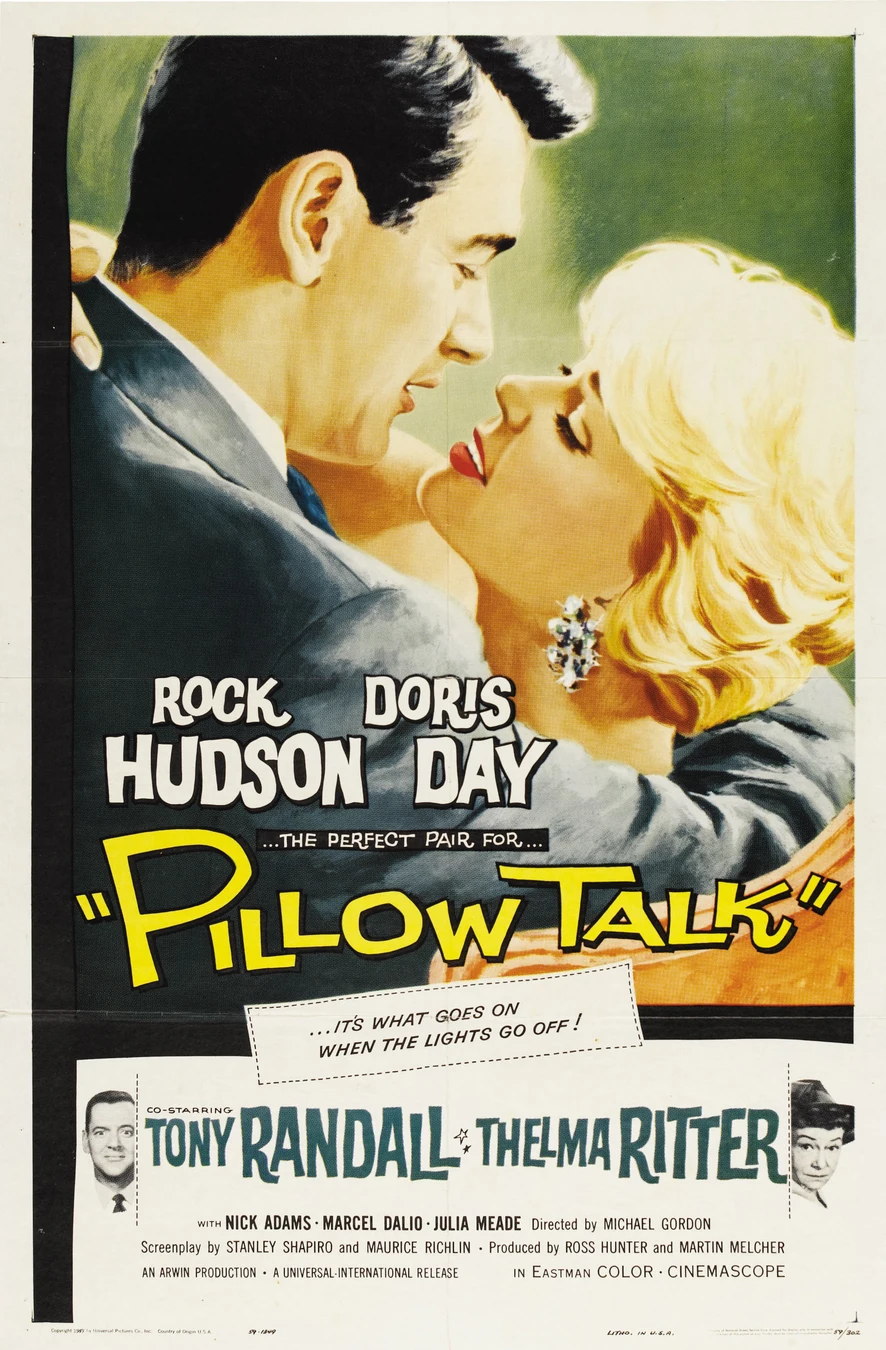
Pillow Talk is a 1959 American romantic comedy film in CinemaScope directed by Michael Gordon and starring Rock Hudson and Doris Day. The supporting cast features Tony Randall, Thelma Ritter, Nick Adams, Allen Jenkins, Marcel Dalio and Lee Patrick. The film was written by Russell Rouse, Maurice Richlin, Stanley Shapiro, and Clarence Greene. It tells the story of Jan Morrow (Day), an interior decorator, and Brad Allen (Hudson), a womanizing composer and bachelor, who share a telephone party line. When she unsuccessfully files a complaint against him for constantly using the line to woo his conquests, Brad finds out she is pretty and decides to trick her by masquerading as a Texas rancher. The scheme seems to work until their mutual friend Jonathan Forbes (Randall) finds out about it and exposes Brad. According to a "Rambling Reporter" (August 28, 1959) item in The Hollywood Reporter, RKO originally bought the script, by Russell Rouse and Clarence Greene, in 1942 but, because it was not produced, the writers bought it back in 1945. In 1947, they sold it as a play, but bought it back once again four years later, finally selling it in 1958 to Arwin Productions, the company owned by Doris Day's husband, Martin Melcher. Although the film was originally titled Pillow Talk, according to a February 2, 1959 "Rambling Reporter" item in The Hollywood Reporter, the title "displeased" the PCA, and was changed to Any Way the Wind Blows. In August 1959, however, the original title was reinstated. The film won the Academy Award for Best Original Screenplay, and was nominated for Best Actress in a Leading Role (Doris Day), Best Actress in a Supporting Role (Thelma Ritter), Best Art Direction-Set Decoration, Color (Richard H. Riedel, Russell A. Gausman, Ruby R. Levitt) and Best Music, Scoring of a Dramatic or Comedy Picture. It the first of three romantic comedies in which Day, Hudson and Randall starred together, the other two being Lover Come Back (1961) and Send Me No Flowers (1964). Upon its release, Pillow Talk brought in a then staggering domestic box-office gross of $18,750,000 and marked a comeback in Rock Hudson's career, after the failure of A Farewell to Arms two years earlier. On July 14, 1980, Jack Martin reported that Pillow Talk was the "biggest hit of 1959". In 2009, it was selected for preservation in the National Film Registry by the Library of Congress for being "culturally, historically or aesthetically significant".
From Wikipedia contributors · CC BY-SACast
Behind the film
Storyline (spoilers)
Jan Morrow is an interior decorator in New York City. She lives alone and claims to be happy when questioned on that subject by her drunken housekeeper, Alma. The only irritant in her life is the party line that she shares with Brad Allen, a Broadway composer and playboy who lives in a nearby apartment building. She cannot obtain a private phone line for her business, which she runs from home, because the telephone company has been overwhelmed by recent demand for new phone lines.
Development
The film's script was turned down and bought back by RKO a few times in the late 1940s and early 1950s until Martin Melcher (the husband of Doris Day at the time) and his Arwin Productions label bought the script and took it to Universal. According to Day in A.E. Hotchner's biography Doris Day: Her Own Story, the film was titled Pillow Talk, but the title displeased the Production Code Administration (PCA). Melcher tried to get co-producer Ross Hunter to change the name to Any Way the Wind Blows, the name of a song he was about to publish, but Hunter stuck with the original name.
Filming
According to Hudson, the final scene, in which Brad storms into Jan's apartment and yanks her out of bed, and carries her through the streets of Manhattan, back to his re-decorated apartment, was actually shot first. Due to back problems, Hudson carried Day on a shelf with her sheets and blankets over her to get through the many takes. According to Hudson, "I could have managed if only one take had been involved, but we went on endlessly, primarily because there was a bit actor who played a cop on the street, and as we passed him Doris' line was 'Officer, arrest this man,' and the cop was supposed to say to me, 'How you doing, Brad?' but that stupid actor kept calling me Rock (01:39:36). So back to our marks we went for another take and another and another. I'll bet we did that scene twenty times.
Box office
The film was a box office hit, grossing $18,750,000 domestically. It was number one at the U.S. box office for seven consecutive weeks. This made Hunter's vision of pairing Day and Hudson together so successful, that they earned Allied's "male and female star of the year" awards for 1959.
Directed by
Written by
Title details
- Release year
- 1959
- Runtime
- 102 min
- Distributors
- Netflix, Universal Pictures
- Genres
- romantic comedy
- Language
- English
- Country of origin
- United States
Awards and nominations
Awards received (1)
- Academy Award for Best Writing, Original Screenplay
Nominations (5)
- Academy Award for Best Actress
- Academy Award for Best Art Direction, Color
- Academy Award for Best Original Dramatic or Comedy Score
- Academy Award for Best Supporting Actress
- Academy Award for Best Writing, Original Screenplay