
Overview
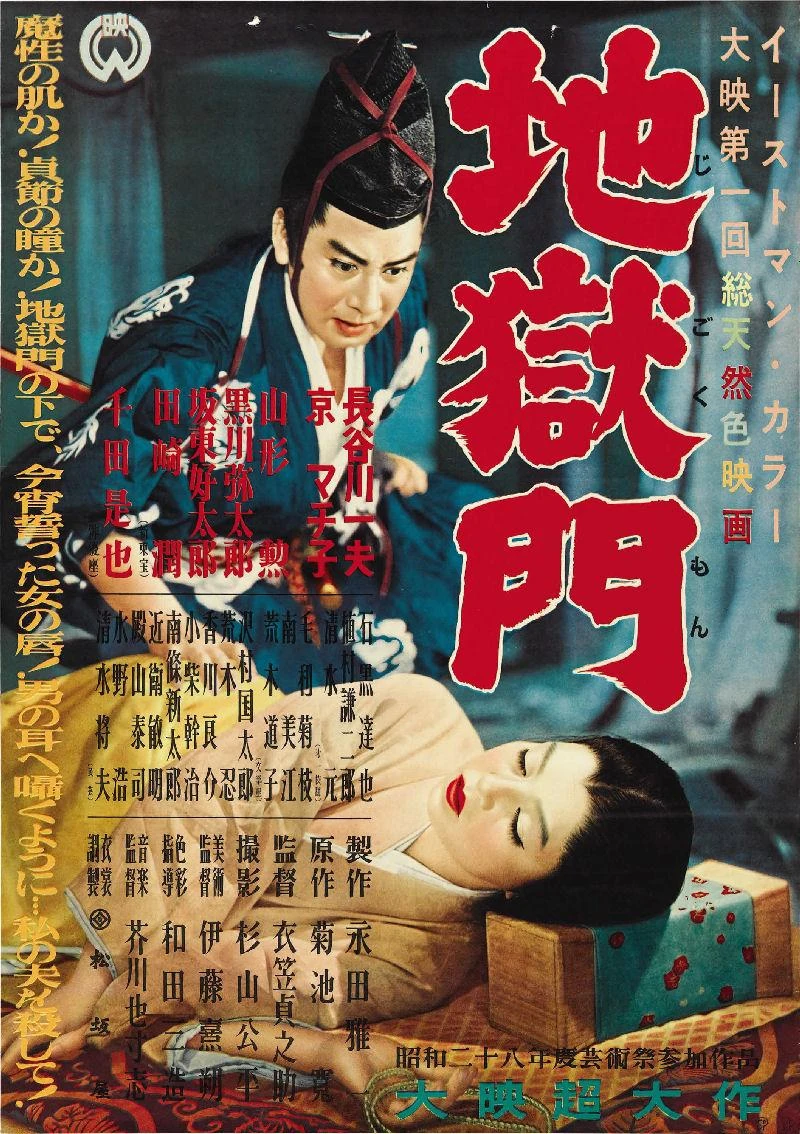
Gate of Hell (Japanese: 地獄門, Hepburn: Jigokumon) is a 1953 Japanese jidaigeki film directed by Teinosuke Kinugasa. It tells the story of a samurai (Kazuo Hasegawa) who tries to marry a woman (Machiko Kyō) he rescues, only to discover that she is already married. Filmed using Eastmancolor, Gate of Hell was Daiei Film's first color film and the first Japanese color film to be released outside Japan. It was digitally restored in 2011 by the National Film Center of the National Museum of Modern Art, Tokyo and Kadokawa Shoten Co., in cooperation with NHK. It was based on the play Kesa's Husband by Kan Kikuchi. The film won Best Costume Design and Best Foreign Language Film at the 27th Academy Awards and the Grand Prize (the top prize of that year) at the 1954 Cannes Film Festival.
From Wikipedia contributors · CC BY-SACast
Behind the film
Storyline (spoilers)
During the Heiji Rebellion, samurai Endō Morito is assigned to escort lady-in-waiting Kesa away from the palace after she had volunteered to disguise herself as the daimyō’s sister, giving the daimyō’s father and real sister time to escape unseen. Kesa is knocked unconscious when the rebels attack their caravan, and Morito takes her to his brother’s home. When Morito’s brother arrives, he reveals that he too is part of the rebellion and suggests Morito join him. Morito refuses to betray the daimyō, Lord Kiyomori. Once he and Kesa are safe, Morito proves his loyalty to Kiyomori by personally riding to him to deliver news about the insurrection, including his brother's disloyalty.
Original title · 地獄門
Directed by
Written by
Title details
- Release year
- 1953
- Runtime
- 88 min
- Genres
- drama film
- Language
- Japanese
- Country of origin
- Japan