
Overview
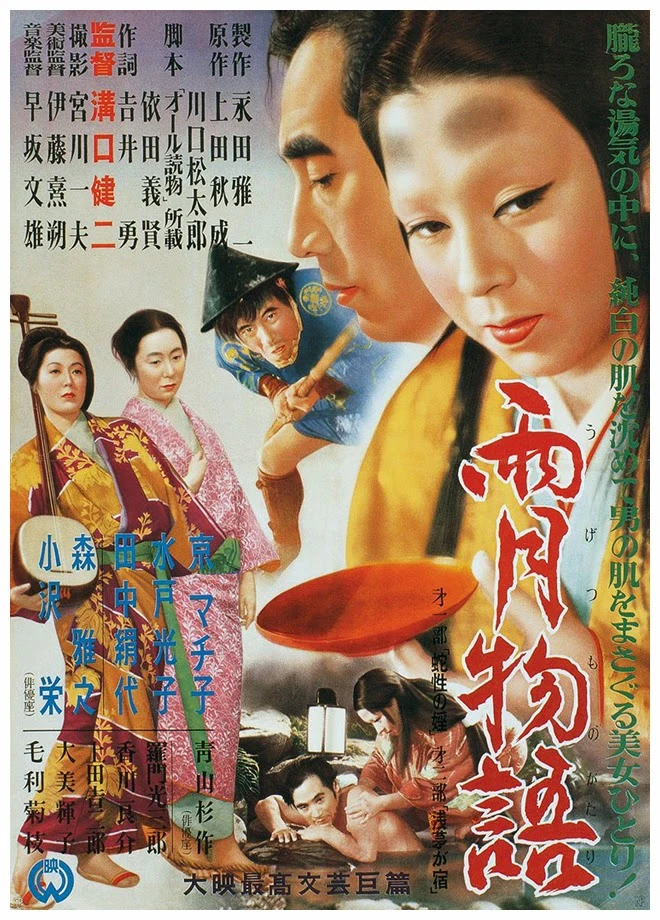
Ugetsu (雨月物語, Ugetsu Monogatari, lit. "Rain-moon tales") is a 1953 Japanese period fantasy film directed by Kenji Mizoguchi starring Masayuki Mori and Machiko Kyō. It was written by Matsutarō Kawaguchi and Yoshikata Yoda based on the stories "The House in the Thicket" and "The Lust of the White Serpent" from Ueda Akinari's 1776 book Ugetsu Monogatari, combining elements of the jidaigeki (period drama) genre with a ghost story. Drawing from Ueda's tales, the film is set in Japan's civil war–torn Azuchi–Momoyama period (1568–1600). In a small rural community, a potter leaves his wife and young son behind to make money selling pottery and ends up being seduced by a spirit that makes him forget all about his family. A subplot, inspired by Guy de Maupassant's 1883 short story "How He Got the Legion of Honor" ("Décoré!"), involves his brother-in-law, who dreams of becoming a samurai and chases this goal at the unintended expense of his wife. The film won the Silver Lion Award at the 1953 Venice Film Festival and other honours. Ugetsu is one of Mizoguchi's most celebrated films, regarded by critics as a masterpiece of Japanese cinema and one of the greatest films of all time, credited with simultaneously helping to popularize Japanese cinema in the West and influencing later Japanese film.
From Wikipedia contributors · CC BY-SACast and characters
- Machiko Kyō
- Lady Wakasa
- Mitsuko Mito
- Ohama
- Kinuyo Tanaka
- Miyagi
- Masayuki Mori
- Genjūrō
- Eitaro Ozawa
- Tōbei
- Ichisaburo Sawamura
- Genichi
- Kikue Mōri
- Ukon
- Ryōsuke Kagawa
- Village Master
- Eigoro Onoe
- Knight
- Saburo Date
- Vassal
- Sugisaku Aoyama
- Old Priest
- Reiko Kongo
- an Old Woman in Brothel
- Shozo Nanbu
- Shinto Priest
- Ichirō Amano
- Boatsman
- Kichijirō Ueda
- Shop Owner
- Teruko Omi
- Prostitute
- Keiko Koyanagi
- Prostitute
- Mitsusaburō Ramon
- Captain of Tamba Soldiers
Behind the film
Storyline (spoilers)
In the farming village of Nakanogō, on the shore of Lake Biwa in Ōmi Province during the Sengoku period, Genjūrō, a potter, takes his wares to nearby Ōmizo. He is accompanied by his brother-in-law, Tōbei, who dreams of becoming a samurai. A respected sage advises Genjūrō's wife, Miyagi, to warn him about seeking profit in times of upheaval and to prepare for an attack on the village. Upon returning with his profits, Miyagi pleads with him to stop, but Genjūrō persists in working to finish his pottery. That night, Lord Shibata Katsuie's army sweeps through Nakanogō, uprooting Genjūrō, Tōbei, and their wives. Genjūrō decides to take his pots to a different marketplace.
Development
After the success of his previous film The Life of Oharu (1952), Mizoguchi was offered to make a film by his old friend Masaichi Nagata at Daiei Film studios. The deal promised Mizoguchi complete artistic control and a large budget. Despite this, Mizoguchi was eventually pressured to make a less pessimistic ending for the film. Mizoguchi's screenwriter and long-time collaborator Yoshikata Yoda said that originally, Mizoguchi did not envision making an anti-war film, instead wishing to capture the sensations and lucidity of Ueda's book Ugetsu Monogatari.
Filming
Mizoguchi told his cinematographer Kazuo Miyagawa that he wanted the film "to unroll seamlessly like a scroll-painting". The film has been praised for its cinematography, such as the opening shot and the scene where Genjūrō and Lady Wakasa have sex by a stream and the camera follows the flow of the water instead of lingering on the two lovers. To achieve the appearance the filmmakers wanted, Miyagawa kept lighting low and filmed as near to sunset as circumstances would allow.thumb|Shooting of Ugetsu|left
Awards
Ugetsu won the Silver Lion Award for Best Direction at the Venice Film Festival in 1953. and won two awards at the 8th Mainichi Film Awards.
Original title · 雨月物語
Directed by
Written by
Cast
Title details
- Release year
- 1953
- Runtime
- 96 min
- Genres
- fantasy film, drama film
- Language
- Japanese
- Country of origin
- Japan