
Overview
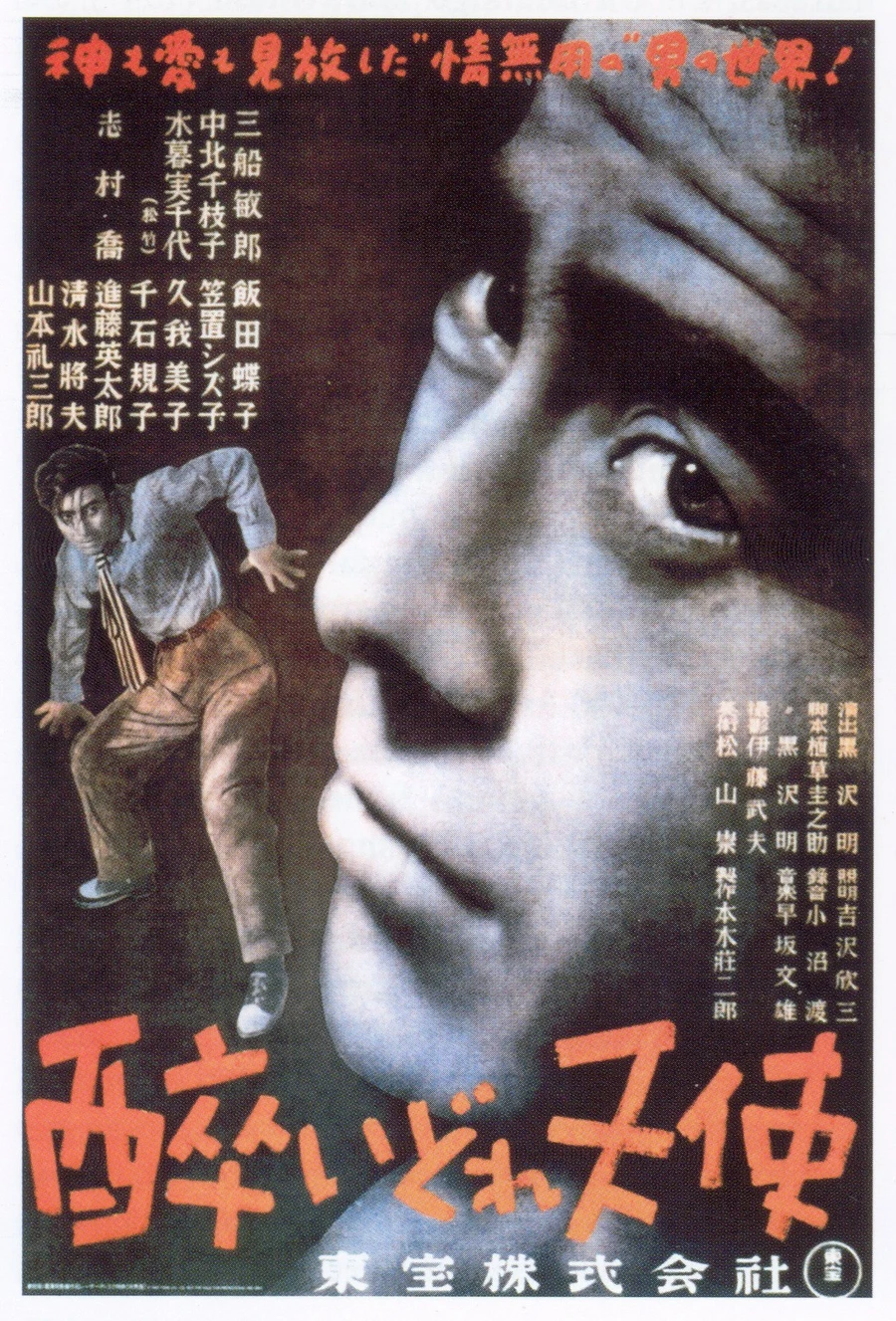
Drunken Angel (Japanese: 醉いどれ天使, Hepburn: Yoidore Tenshi) is a 1948 Japanese yakuza film directed by Akira Kurosawa and co-written by Kurosawa and Keinosuke Uekusa. Produced by Toho and starring Takashi Shimura and Toshiro Mifune, it tells the story of the alcoholic doctor Sanada and his yakuza patient Matsunaga. Sanada tries to save Matsunaga from illness and the corruption brought about by the crime in the community while Matsunaga finds himself gradually sidelined within the syndicate and becomes increasingly self-destructive. The film was the first to depict the post-Second World War yakuza and is generally considered to be Kurosawa's first major work. During the writing of the screenplay Kurosawa and Uekusa clashed over Uekusa's growing sympathies with the yakuza due to his regular meetings with a life-model to study for the character Matsunaga. Production began in 1947 amid a series of labour disputes in the Toho company. Filming lasted from November of that year to March 10, 1948. During production, Kurosawa encountered a number of setbacks, including the death of his father in February 1948. The film was the first of sixteen collaborations between Kurosawa and Mifune, and the first collaboration between Kurosawa and Fumio Hayasaka. Kurosawa's work on Drunken Angel prompted him to think more about the relationship between music and image in film. Despite facing censorship from the Civil Information and Education Section of the Allied occupation government, the film was released in Japan on April 27, 1948, to generally positive reviews. The film won awards for Best Film from Kinema Junpo and Mainichi Shimbun. After the international success of Rashomon (1950) at the 1951 Venice Film Festival, Toho promoted the film abroad. Analyses of Drunken Angel have looked at the pairing of multiple characters and their interactions in the postwar environment, with discussions focussing on the morality of its characters (the titular 'drunken angel'), intertextual references to the novels of Fyodor Dostoevsky and contemporary noir fiction, and the symbolic meaning of the sump—a kind of open cesspool—seen throughout much of the film.
From Wikipedia contributors · CC BY-SACast and characters
- Takashi Shimura
- Doctor Sanada
- Toshiro Mifune
- Matsunaga
- Michiyo Kogure
- Nanae
- Chieko Nakakita
- Nurse Miyo
- Eitarō Shindō
- Takahama
- Shizuko Kasagi
- singer
- Masao Shimizu
- Oyabun
- Yoshiko Kuga
- schoolgirl
Behind the film
Storyline (spoilers)
Sanada is an alcoholic doctor living in a shanty town next to an open sump. He treats a small-time named Matsunaga—who was injured in a gunfight with a rival syndicate—despite his dislike of organised crime. Sanada diagnoses Matsunaga with tuberculosis; Matsunaga's initially violent reaction is interrupted by the arrival of Sanada's nurse Miyo. The following day Sanada goes to the local black market—which Matsunaga controls—in a bar, he attempts to persuade Matsunaga to give up drinking and smoking; Matsunaga kicks him out. Sanada and Miyo discuss the imminent release from prison of Matsunaga's fellow yakuza and sworn brother, Okada, Miyo's abusive ex-boyfriend. Sanada continues treating other patients, including a young female student making progress against her tuberculosis. After some pestering, Matsunaga agrees to listen to the doctor's advice and quit drinking.
Development
Drunken Angel was made in the context of a series of labour disputes with the Toho company, a major Japanese film studio. The powerful trade union had managed the production of films, with Kurosawa's prior works No Regrets for Our Youth (1946) and One Wonderful Sunday (1947) requiring the approval of the union. By the end of 1947, the union's influence had waned following a series of less profitable Toho releases. As a result, Kurosawa was able to produce the film with minimal interference from the studio and its union. Kurosawa co-wrote the film with his childhood friend Keinosuke Uekusa in their second and last collaboration. While staying at an inn at the seaside resort Atami, Kurosawa noticed that the prow of a sunken concrete ship was being used as a diving board by local children. Seeing it as an apt metaphor for Japan's defeat in the Second World War, this image became the open sump—a kind of cesspool—seen in Drunken Angel.
Original title · 醉いどれ天使
Directed by
Written by
Cast
Title details
- Release year
- 1948
- Runtime
- 98 min
- Genres
- drama film, film noir
- Language
- Japanese
- Country of origin
- Japan