
Overview
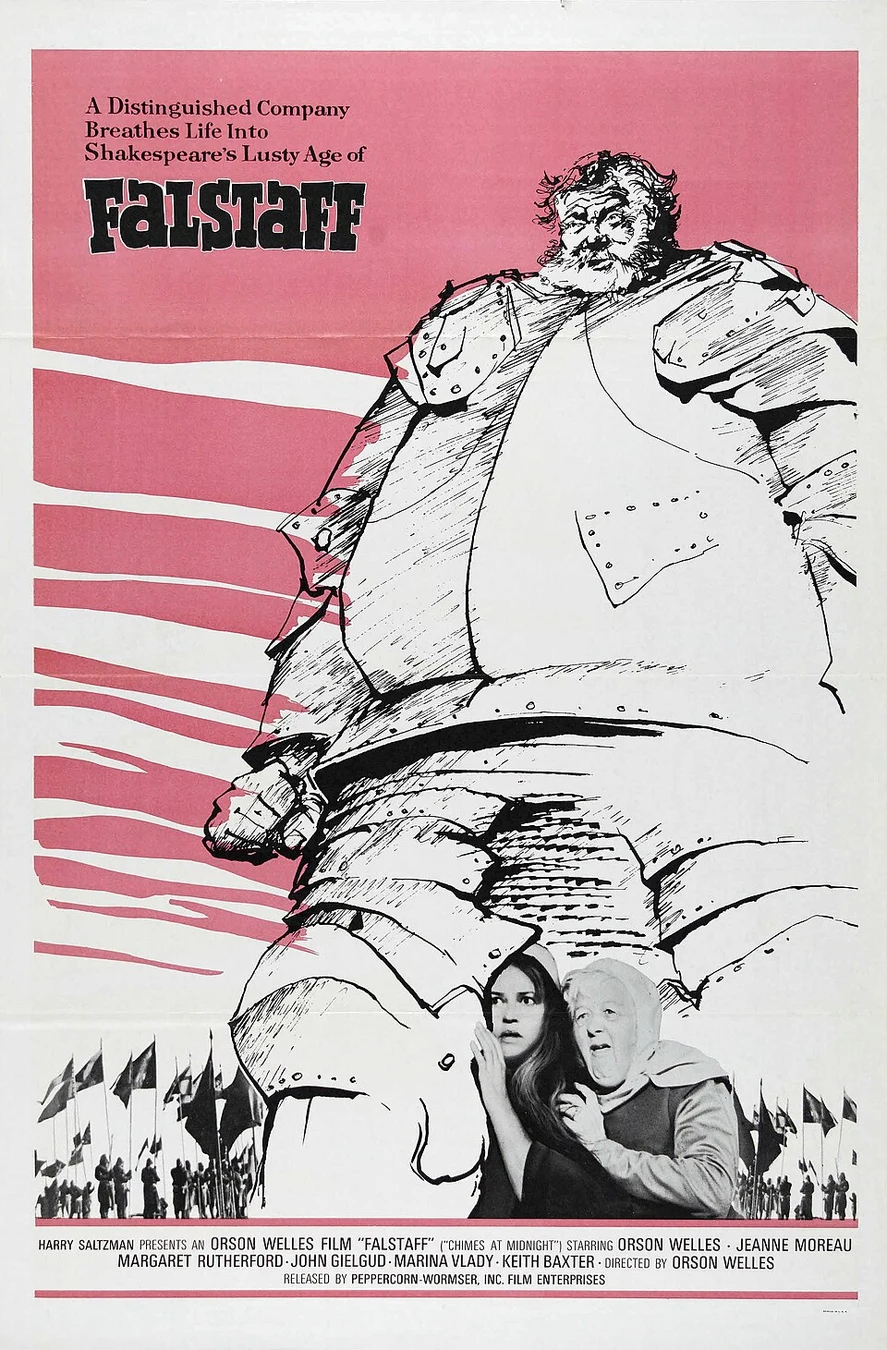
Chimes at Midnight (Spanish: Campanadas a medianoche, released in most of Europe as Falstaff) is a 1965 period comedy-drama film written, directed by, and starring Orson Welles. Its plot centers on William Shakespeare's recurring character Sir John Falstaff and his fatherly relationship with Prince Hal, who must choose loyalty to Falstaff or to his actual father, King Henry IV. The English-language film was an international co-production of Spain, France, and Switzerland. Welles said that the core of the film's story was "betrayal of friendship". It stars Welles as Falstaff, Keith Baxter as Prince Hal, John Gielgud as Henry IV, Jeanne Moreau as Doll Tearsheet, and Margaret Rutherford as Mistress Quickly. The script contains text from five of Shakespeare's plays, primarily Henry IV, Part 1 and Henry IV, Part 2, but also Richard II, Henry V, and The Merry Wives of Windsor. Ralph Richardson's narration is taken from the works of chronicler Raphael Holinshed. Welles had produced a Broadway stage adaptation of nine Shakespeare plays, Five Kings, in 1939. In 1960, he revived this project in Ireland as Chimes at Midnight, which was his final stage performance. Neither of these plays was successful, but Welles considered portraying Falstaff his life's ambition and turned the project into a film. To get financing, he lied to producer Emiliano Piedra that he intended to make a version of Treasure Island, and keeping the film funded during its production was a constant struggle. Welles shot Chimes at Midnight in Spain between 1964 and 1965; it premiered at the 1966 Cannes Film Festival, winning two awards there. Initially dismissed by most film critics, Chimes at Midnight is now regarded as one of Welles's highest achievements, and Welles called it his best work. Welles felt a strong connection to the character of Falstaff and called him "Shakespeare's greatest creation". Some film scholars and Welles's collaborators have made comparisons between Falstaff and Welles, while others see a resemblance between Falstaff and Welles's father. Disputes over the ownership of Chimes at Midnight made it difficult to view the film legally until recently. It was released in the UK on DVD and Blu-ray in 2015. A new restoration by Janus Films and The Criterion Collection screened at Film Forum in New York on January 1–12, 2016. The Criterion Collection released the film on Blu-ray and DVD on August 30, 2016.
From Wikipedia contributors · CC BY-SACast and characters
- Orson Welles
- Sir John Falstaff
- Keith Baxter
- Prince Hal
- John Gielgud
- King Henry IV
- Margaret Rutherford
- Mistress Quickly
- Jeanne Moreau
- Doll Tearsheet
- Alan Webb
- Justice Shallow
- Walter Chiari
- Justice Silence
- Michael Aldridge
- Pistol
- Tony Beckley
- Ned Poins
- Charles Farrell
- Bardolph
- José Nieto
- Earl of Northumberland
- Keith Pyott
- the Lord Chief Justice
- Fernando Rey
- Earl of Worcester
- Norman Rodway
- Henry Percy
- Marina Vlady
- Kate Percy
- Andrew Faulds
- Earl of Westmorland
- Jeremy Rowe
- Prince John
Behind the film
Storyline (spoilers)
Sir John Falstaff and Justice Shallow walk through the snow, then to a warm fire inside Shallow's home in Gloucestershire, as the two reminisce. King Henry IV of England has succeeded Richard II, whom he has killed. Richard II's true heir, Edmund Mortimer, is a prisoner in Wales, and Mortimer's cousins (the Percys) Northumberland, Worcester, and Northumberland's son Henry Percy (called "Hotspur") demand that the king rescue Mortimer. He refuses, and the Percys begin to plot his overthrow.
Filming
The film was shot in Spain from September 1964 to April 1965, with a break from late December to late February. Welles's limitations on the film included a budget of $800,000 and actors Jeanne Moreau and John Gielgud being available for five and ten days respectively, while Margaret Rutherford was available for only four weeks. Welles later joked that during one scene that included seven principal characters, none of the actors was available at the same time and stand-ins were used for over-the-shoulder shots of all seven. Filming began in Colmenar and included all of Gielgud's scenes. Welles then traveled to Cardona, where the Royal Court scenes and Marina Vlady's scenes were shot, and to Madrid's Casa de Campo Park, where the Gadshill robbery scene was filmed. Madrid was also the location of the Boar's Head Tavern set, where Welles shot Moreau's and Rutherford's scenes.
Directed by
Written by
Cast
Title details
- Release year
- 1965
- Runtime
- 119 min
- Genres
- drama film, medieval film, comedy film, war film
- Language
- English
- Country of origin
- Spain, Switzerland, France