
Overview
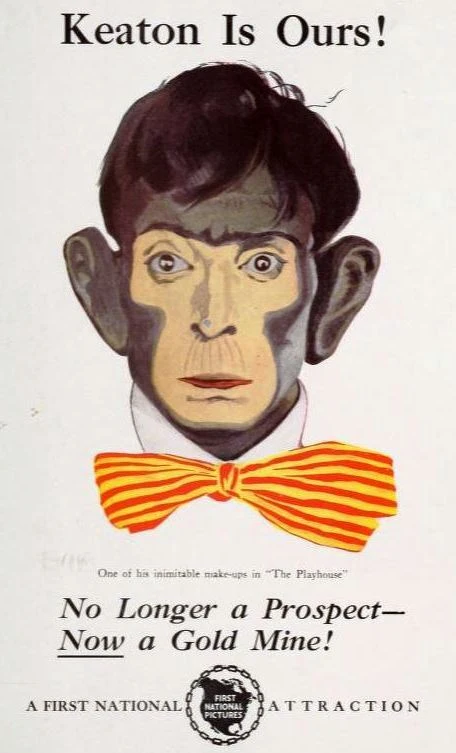
The Play House is a 1921 American two-reel silent comic trick film written by, directed by, and starring Buster Keaton. It runs for 22 minutes, and is most famous for an opening sequence in which Keaton plays every role.
From Wikipedia contributors · CC BY-SACast and characters
- 'Buster' Keaton
- Audience / Orchestra / Mr
- Eddie Cline
- Orangutan trainer
- Virginia Fox
- Twin
- Joe Roberts
- Actor-Stage Manager
- Monte Collins
- Civil War Veteran
- Joe Murphy
- One of the Zouaves
- Jess Weldon
- One of the Zouaves
- Ford West
- Stage Hand
Behind the film
Storyline (spoilers)
The film is set up as a series of humorous tricks on the audience, with constant doubling, and in which things are rarely what they at first seem to be. It opens with Keaton attending a variety show. Keaton plays the conductor and every member of the orchestra, the actors, dancers, stagehands, minstrels and every member of the audience, male and female. As an audience member, Keaton turns to the "woman" sitting beside him and remarks: "This fellow Keaton seems to be the whole show". This was a jibe at one of Keaton's contemporaries, Thomas Ince, who credited himself generously in his film productions.
Development
Keaton had fractured his ankle in the film he worked on before this one, so The Play House relied more on cinematic techniques and sight gags than stunt work. It references gags from Keaton's vaudeville career with The Three Keatons, and also draws themes from the performances of Annette Kellerman, who employed 100 mirrors to create the illusion that there was more than one of her. While Keaton played all the parts in the first scene of the play, he had considered playing all the parts in the entire film. But he refrained from doing so out of the concern that "audiences might tire of the joke or think he made it as a demonstration of his acting virtuosity". He later regretted not having acted all the parts throughout.
Filming
Keaton's portrayal of nine members of a minstrel show required the use of a special matte box in front of the camera lens. It had nine exactingly-machined strips of metal which could be moved up and down independently of each other. Elgin Lessley, Keaton's cameraman, shot the far-left Keaton with the first shutter up, and the others down. He then rewound the film, opened the second segment, and re-filmed the next Keaton in sequence. This procedure was repeated seven more times. The camera was hand-wound, so Lessley's hand had to be absolutely steady during filming to avoid any variation in speed. Keaton synchronized his movements for each character's dance to the music of a banjo player who was playing along with a metronome – not a problem in a silent film. It was decades before Keaton, who masterminded this, revealed his technique to other filmmakers.
Directed by
Written by
Cast
Title details
- Release year
- 1921
- Runtime
- 23 min
- Distributors
- First National Pictures
- Genres
- silent film, comedy film
- Country of origin
- United States