
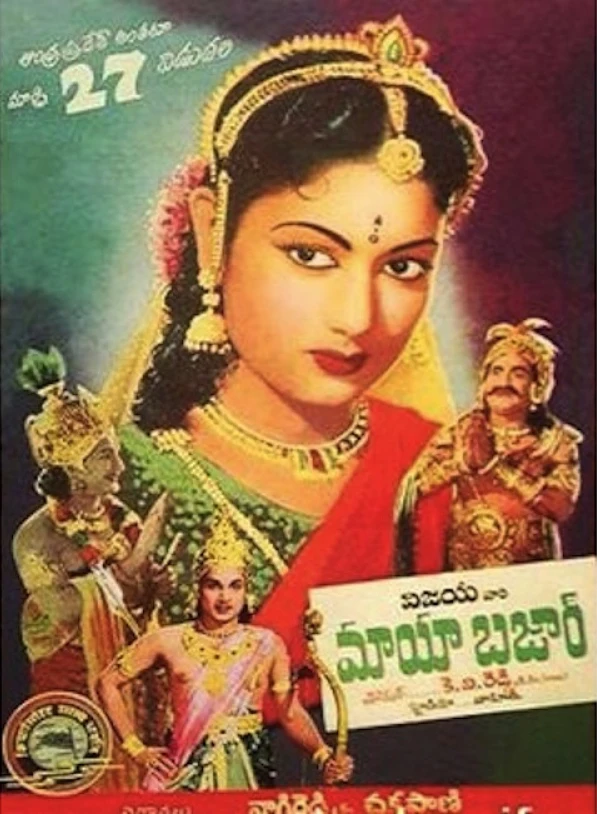
Overview
Mayabazar (transl. Market of Illusions) is a 1957 Indian Hindu mythological film directed by K. V. Reddy. The epic was produced by Nagi Reddi and Chakrapani under their banner, Vijaya Productions. Produced by Telugu cinema, it was shot simultaneously in Telugu and Tamil, with a few differences in the cast. The story is an adaptation of the folk tale Sasirekha Parinayam, which is based on the characters of the Sanskrit epic Mahabharata. It revolves around the roles of Krishna (N. T. Rama Rao) and Ghatotkacha (S. V. Ranga Rao), as they try to reunite Arjuna's son Abhimanyu (Telugu: Akkineni Nageswara Rao, Tamil: Gemini Ganesan) with his love, Balarama's daughter Sasirekha (Savitri). The Telugu version features Gummadi, Mukkamala, Ramana Reddy, and Relangi in supporting roles, with D. Balasubramaniam, R. Balasubramaniam, V. M. Ezhumalai, and K. A. Thangavelu playing those respective parts in the Tamil version. The first mythological film produced by their studio, Mayabazar marked a milestone for Nagi Reddi and Chakrapani. In addition to the technical crew, 400 studio workers – including light men, carpenters, and painters – participated in the development of the film. Director Reddy was meticulous with the pre-production and casting phases, which took nearly a year to complete. Though Rama Rao was initially reluctant to play the lead role, his portrayal of Krishna received acclaim and yielded more offers to reprise the same role in several unrelated films. The soundtrack features twelve songs, with most of the musical score composed by Ghantasala. Telugu lyrics were written by Pingali Nagendrarao and Tamil lyrics were written by Thanjai N. Ramaiah Dass. One of those songs, Lahiri Lahiri, was accompanied by the first illusion of moonlight in Indian cinema, shot by cinematographer Marcus Bartley. Mayabazar's Telugu version was released on 27 March 1957; the Tamil version was released two weeks later, on 12 April. Both were critically and commercially successful, with a theatrical run of 100 days in 24 theatres, and it became a silver-jubilee film. The Telugu version of Mayabazar was also dubbed into Kannada. The film is considered a landmark in both Telugu and Tamil cinema, with praise for its cast and technical aspects, despite the limitations of technology at the time. On the centenary of Indian cinema in 2013, CNN-IBN included Mayabazar in its list of "100 greatest Indian films of all time". In an online poll conducted by CNN-IBN among those 100 films, Mayabazar was voted by the public as the "greatest Indian film of all time." Mayabazar became the first Telugu film to be digitally remastered and colourised, at an estimated cost of ₹7.5 crore (valued at about US$1.7 million in 2010), after Hyderabad-based company Goldstone Technologies acquired world negative rights to fourteen films including that of Mayabazar in late November 2007. The updated version was released on 30 January 2010 in 45 theatres in Andhra Pradesh. It was a commercial success that generated mostly positive reviews, with one critic expressing a preference for the original.
From Wikipedia contributors · CC BY-SACast and characters
- Savitri
- Sasirekha
- Vangara
- Shastri
- Allu Ramalingaiah
- Sharma
- Valluri Balakrishna
- Sarathi
- Rushyendramani
- Subhadra
- Sandhya
- Rukmini
- Nagabhushanam
- Satyaki
- Chadalavada
- Lambu
- Nalla Ramamurthy
- Jambu
- Madhavapeddi Satyam
- Daaruka
- Kanchi Narasimha Rao
- an old man
- Boddapati
- Sankuteerthulu
- Baby Saraswati
- young Sasirekha
- Master Anand
- young Abhimanyu
- Rajani
- Bhanumati
- Master Babji
- young Krishna in a play
- Kakinada Rajaratnam
- Yashoda in a play
- Guru Gopinath
- Bhasmasura in Mohini Bhasmasura dance drama
Behind the film
Storyline (spoilers)
Subhadra (the sister of Balarama and Krishna) marries a Pandava named Arjuna. Their son Abhimanyu falls in love with Balarama's daughter, Sasirekha. The families consent to their marrying when they reach adulthood. When Abhimanyu and Sasirekha have grown up, Krishna introduces them to each other. One day, the Pandavas are invited by Duryodhana, the eldest of the Kauravas to join in a game of dice. Duryodhana's uncle, Shakuni, manipulates the results of the game, thereby costing the Pandavas their wealth, their liberty, and their wife Draupadi. Duryodhana's brother, Dushasana, attempts to disrobe Draupadi. He is seen by Krishna, who, furious, comes to her rescue. On hearing what happened to the Pandavas, Balarama decides to teach the Kauravas a lesson and travels to their capital Hastinapuram.
Development
After the success of Pathala Bhairavi (1951), the production company, Vijaya Productions, selected the film's technical crew for an adaptation of Sasirekha Parinayam (1936), also known as Mayabazar. The eighth adaptation of the folk tale Sasirekha Parinayam, it was the studio's first mythological film.
Filming
During rehearsals, K. V. Reddy timed his actors with a stopwatch, calculating the length of each scene (including songs) to determine the film's length. Its outdoor filming lasted for 10 to 15 seconds. Bartley then created an illusion of moonlight, which according to Ambu Rao was a first for an Indian film. Nageswara Rao was injured on the film's set, and action sequences featuring himself and Ranga Rao were shot only after his recovery, causing a three-month delay in the release of the film. Ganesan volunteered to act as Nageswara Rao's body double in a scene where Abhimanyu would jump from a second-floor balcony.
Original title · మాయాబజార్
Directed by
Written by
Cast
Title details
- Release year
- 1957
- Genres
- fantasy film
- Language
- Telugu, Tamil
- Country of origin
- India