
Overview
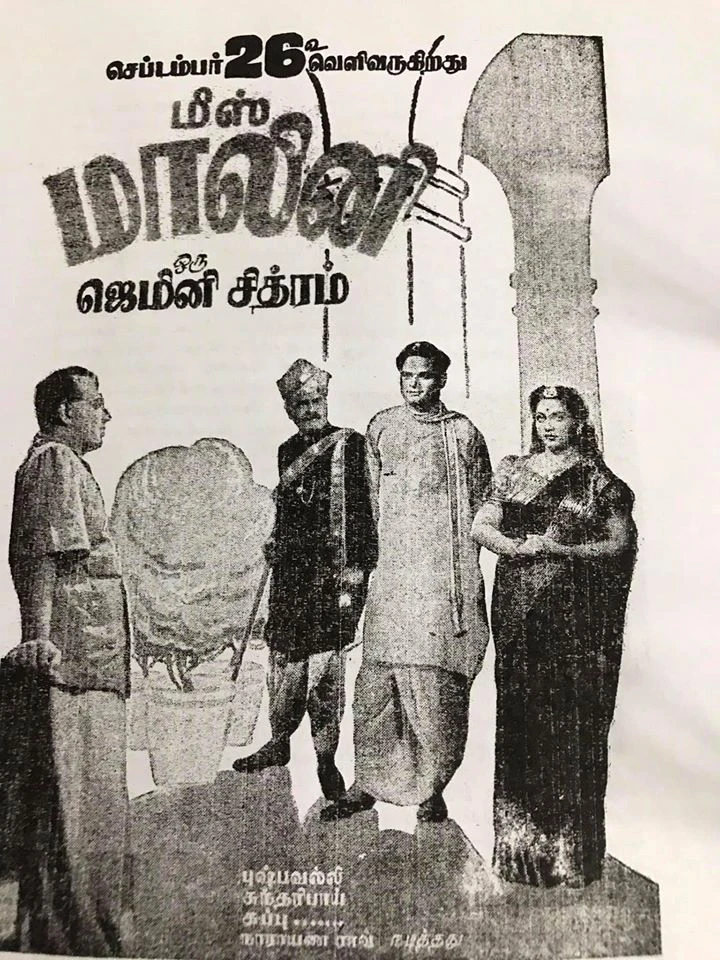
Miss Malini is a 1947 Indian Tamil-language satirical comedy drama film written and directed by Kothamangalam Subbu and produced by K. Ramnoth, from a story by R. K. Narayan. Subbu also starred in the film alongside Pushpavalli, Sundari Bai and Subbiah Pillai. Javar Seetharaman and Gemini Ganesan made their acting debuts in the film appearing in minor roles. The film focuses on Malini (Pushpavalli), an impoverished woman who joins her actress friend Sundari's (Sundari Bai) theatre company and becomes a success. Matters worsen when she befriends Sampath (Subbu), a charlatan. Miss Malini ridiculed aspects of life in Madras (now Chennai) during the World War II period, and was the only story written by Narayan for the screen that was made into a film. It was released on 26 September 1947, and was accompanied in theatres by Cinema Kadhambam, the first animated film produced in South Indian cinema. Miss Malini was praised by intellectuals; Subbu's performance as Sampath was widely appreciated. The songs composed by S. Rajeswara Rao and Parur S. Anantharaman became popular, and the film gained cult status in Tamil cinema. Miss Malini marked Narayan's earliest use of story elements that would recur in some of his later novels. It was later rewritten by him as the 1949 novel Mr. Sampath – The Printer of Malgudi, which in turn was adapted into the Hindi film Mr. Sampat (1952) directed by S. S. Vasan, and a 1972 Tamil film directed by Cho Ramaswamy. Although no print of Miss Malini is known to survive, thereby making it a lost film, surviving artefacts include its songs, along with a few stills and newspaper advertisements.
From Wikipedia contributors · CC BY-SACast
Behind the film
Storyline (spoilers)
Malini is an indigent woman whose father is in poor health. She is persuaded by her friend Sundari, an actress, to join her theatre company, Kala Mandhiram. Malini soon becomes very successful and popular. She is later befriended by Sampath, a charlatan, who is regularly involved in dodging creditors. Deaf to all advice, Malini allows herself to be led astray in professional, financial and moral terms. She is put out of Kala Mandhiram and sets up a theatre company of her own where Sampath appoints himself as general manager. Malini severs ties with those who previously helped her, including Sundari. At first, the new company prospers, but its resources are soon squandered by Sampath and it falls under a weight of debt and disgrace. Sampath abandons Malini, who falls back to her previous destitute condition. However, with Sundari's help, she returns to Kala Mandhiram and begins her life anew.
Box office
According to Randor Guy, Miss Malini was not successful at the box-office, and it took a few years to recover its cost. He attributed the film's failure to its lack of commercial elements that would have helped it reach out to average filmgoers, the fact that it was ahead of its time, and wrote that Vasan lamented that "making films for intellectuals would not bring money"; Guy considered this a "lesson" he learnt from making the film. R.K. Narayan: The Early Years says that the film "paid for itself at the box office". Vasan's son S. S. Balan said the film "fared reasonably well". In April 1954, the magazine Gundoosi column "Nunippul" () said that Ramnoth, not Subbu, was the main reason for the film's success.
Original title · மிஸ் மாலினி
Directed by
Written by
Title details
- Release year
- 1947
- Genres
- comedy drama
- Language
- Tamil
- Country of origin
- British Raj