Overview
Luxo Jr. (also known as Luxo Junior) is a 1986 American animated short film produced and released by Pixar. Written and directed by John Lasseter, the two-minute short film revolves around one larger and one smaller desk lamp. The larger lamp, named Luxo Sr., looks on while the smaller, "younger" Luxo Jr. plays exuberantly with a ball to the extent that it accidentally deflates. Luxo Jr. was Pixar's first animation after Ed Catmull and John Lasseter left the Lucasfilm Computer Division. The film is the source of Luxo Jr., the mascot of Pixar. Lasseter aimed to finish the short film for the 1986 SIGGRAPH, an annual computer graphics conference attended by thousands of industry professionals. The film would come from his experiments with modeling his Luxo lamp. Lasseter worked to improve the story within the allotted two minutes. In animation, the film demonstrates the use of shadow maps within the rendering software. Lasseter applied the classic animation principles popularized by Disney's Nine Old Men to convey the lamps' emotions. Catmull and Lasseter worked around the clock, and Lasseter even took a sleeping bag into work and slept under his desk, ready to work early the next morning. Ultimately, the film took four and a half months to be completed. The short film debuted at SIGGRAPH 1986 in Dallas, Texas. Before the film finished playing, the audience had already risen in applause. Luxo Jr. is regarded as a breakthrough in the animation industry as a whole, changing traditionalists' interpretation of computer animation. The short was the first work of animation to use procedural animation, the software written by Eben Ostby. It received an Academy Award nomination for Best Animated Short Film, becoming the first CGI film nominated for an Academy Award. The soundtrack music is an uncredited edit of three compositions on Brian Bennett's album (from Bruton Music) BRD17: Counterpoint In Rhythm: "Finesse", "Quicksilver", and "Chateau Latour". In 2014, Luxo Jr. was deemed "culturally, historically, or aesthetically significant" by the Library of Congress and selected for preservation in the United States National Film Registry.
From Wikipedia contributors · CC BY-SACast & filmmakers

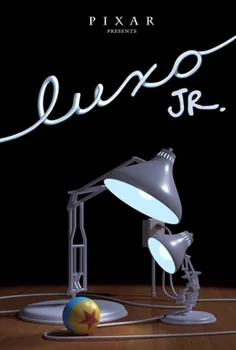
Film poster
Two desk lamps bend toward a ball below the hand-drawn white title.
Poster source · Vybpedia article · Film publicity artworkBehind the film
Storyline (spoilers)
In a dark room, a large illuminated balanced-arm desk lamp named Luxo Sr. sees a small yellow ball with a blue stripe and a red star on the front roll-up to him. He eyes the ball curiously and pushes it away, but the ball comes back to him. He pushes it away again, but it rolls past him as Luxo Jr., his happy and excited son, hops over and plays with the ball. Luxo Jr. then balances himself on top of the ball and bounces on it excessively, causing it to deflate. Luxo Jr. flips the deflated ball onto its side and looks up at Luxo Sr., who gently admonishes his son. Luxo Jr. then hops offscreen in shame but is later seen playing with a beach ball. Luxo Sr. looks at the camera, then shakes his head in embarrassment.
Directed by
Written by
Title details
- Release year
- 1986
- Runtime
- 2 min
- Production companies
- Pixar
- Distributors
- Disney+, Pixar
- Content rating
- G
- Genres
- Animated, Short
- Language
- English
- Country of origin
- United States
Awards and nominations
Nominations (1)
- Academy Award for Best Animated Short Film