
Overview
Mean Streets is a 1973 American crime drama film directed by Martin Scorsese, from a screenplay co-written with Mardik Martin. It stars Harvey Keitel and Robert De Niro, along with David Proval, Amy Robinson, Richard Romanus, and Cesare Danova. Scorsese's third feature film, it depicts a group of troubled young men in New York's Little Italy, and centers on many themes the director would later revisit, including the Mafia, Italian-American identity, urban life, and Catholic guilt. Produced independently and released by Warner Bros. Pictures on October 2, 1973, Mean Streets received positive reviews from critics and marked Scorsese's arrival as a major figure of the New Hollywood movement. Robert De Niro won the National Society of Film Critics and the New York Film Critics Circle awards for Best Supporting Actor for his role as "Johnny Boy" Civello. In 1997, Mean Streets was selected for preservation in the United States National Film Registry by the Library of Congress for being "culturally, historically, or aesthetically significant".
From Wikipedia contributors · CC BY-SACast & filmmakers
Cast and characters
- Amy Robinson
- Teresa
- Lenny Scaletta
- Jimmy
- Jeannie Bell
- Diane
- Martin Scorsese
- Jimmy Shorts
- Murray Moston
- Oscar
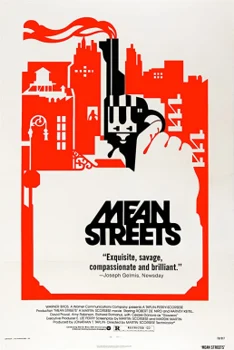
The theatrical poster
A black handgun rises through a flat red cityscape, its barrel doubling as part of the skyline. A red plume above it makes a quiet graphic surface feel dangerous.
Poster source · Vybpedia article · Theatrical release artworkBehind the film
Storyline (spoilers)
Charlie Cappa, a young Italian American in the Little Italy neighborhood of New York City, is hampered by his feeling of responsibility toward his reckless younger friend John "Johnny Boy" Civello, a small-time gambler and degenerate who refuses to work and owes money to many loan sharks. Charlie is also having a secret affair with Johnny's cousin Teresa, who has epilepsy and is ostracized because of her condition—especially by Charlie's Uncle Giovanni, a powerful mafioso, and is told to stay away from her. Giovanni also wants Charlie to distance himself from Johnny, saying that "honorable men go with honorable men".
Development
Apart from his first actual feature, Who's That Knocking at My Door, this was Scorsese's first feature film of his own design. Director John Cassavetes told him after he completed his second film, Boxcar Bertha, a directing project given to him by early independent filmmaker Roger Corman: "You’ve just spent a year of your life making a piece of shit." This inspired Scorsese to make a film about his own experiences, inspired by his upbringing in New York's Little Italy. Cassavetes told Scorsese he should do something like Who's That Knocking at My Door, which Cassavetes had liked.
Filming
Principal photography lasted 27 days, between April and June 1973. Due to the low budget, the majority of the film's interiors were shot in Los Angeles, with seven days of location shooting in New York City. The church scenes were filmed at St. Patrick's Old Cathedral in Little Italy, while the 'Volpe Bar' was a restaurant in the Nolita neighborhood of Manhattan. Many scenes were shot without permits, with Scorsese calling favors from his old friends and neighbors, including Francis Ford Coppola.
Directed by
Written by
Cast
Title details
- Release year
- 1973
- Release date
- 1973-10-02
- Runtime
- 112 min
- Production companies
- Warner Bros. Entertainment
- Distributors
- Netflix, Warner Bros. Entertainment
- Content rating
- R
- Genres
- Drama, Crime
- Language
- English
- Country of origin
- United States of America
 Trailer still

 Trailer still
