Overview
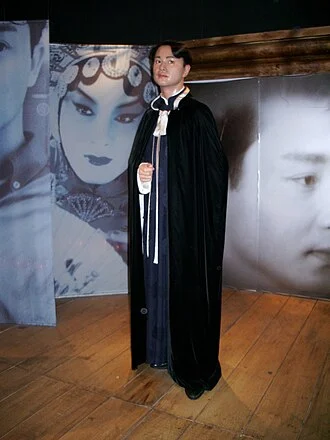
Farewell My Concubine (Chinese: 霸王别姬, lit. 'The Hegemon-King Bids Farewell to His Concubine') is a 1993 epic historical drama film directed by Chen Kaige, starring Leslie Cheung, Gong Li and Zhang Fengyi. Based on the novel of the same name by Lilian Lee, the film is set in unstable 20th-century China, from the early formations of the Republic of China, to the aftermath of the Cultural Revolution. Its narrative depicts the troubled relationships between Peking opera actors Cheng Dieyi, Duan Xiaolou, and Xiaolou's wife Gong Juxian, and their interactions with Chinese politics and society. The film's themes include identity confusion and blurred lines between real life and the stage, embodied by the revered opera actor Dieyi, whose unrequited love for Xiaolou persists throughout. It also addresses themes of political and societal disturbances in 20th-century China, which is typical of Chinese Fifth Generation cinema. A co-production between mainland China and Hong Kong, Farewell My Concubine premiered on 1 January 1993 in Hong Kong. Upon release, the film received generally positive reviews from contemporary critics, and jointly won the Palme d'Or with The Piano at the 1993 Cannes Film Festival, becoming the first Chinese-language film to receive the award. It won further accolades, including a Golden Globe for Best Foreign Language Film and a BAFTA for Best Film Not in the English Language, and received two nominations at the 66th Academy Awards for Best Cinematography and Best Foreign Language Film. A few weeks after its release in China, the Politburo of the Chinese Communist Party demanded changes be made to the film, due to unconventional depictions of traditional values and political sensitivities in its portrayal of the Communist Youth League of China. While allowing a premiere in Shanghai, the government objected to the film's representation of homosexuality and gender identity, the suicide of a leading character, and its recreation of China's 1960s turmoil. The film was approved for further exhibition in September 1993, less than a year after its original release. However, this re-release had 14 minutes trimmed by state censors. Chinese officials felt that a re-release, as opposed to maintaining a full ban, would silence an ever-growing international backlash, and would also help their bid to host the 2000 Olympic Games in Beijing. Distributor Miramax also cut the film by 14 minutes for its United States theatrical release. In 2023, for its 30th anniversary, Film Movement released an uncut 4K restoration of Farewell My Concubine theatrically, followed by a physical media release by The Criterion Collection the following year. Farewell My Concubine is considered one of the landmark films of the Fifth Generation movement that brought Chinese film directors to worldwide attention. In 2005, the film was selected as one of the "100 Best Films in Global History" by Time magazine.
From Wikipedia contributors · CC BY-SACast & filmmakers


Behind the film
Storyline (spoilers)
In 1924 Peking, a young boy by the name of Douzi is abandoned by his prostitute mother to a Peking opera troupe supervised by Master Guan, who like many other opera troupe leaders, would take in orphaned children as apprentices. There, Douzi is mocked by the other children for his mother's origin, but nonetheless is befriended by another boy about his age, Shitou, a boy with a talent for breaking stones with his head.
Awards
At the Cannes Film Festival, the film shared the Palme d'Or with Jane Campion's The Piano from New Zealand.
Original title · 霸王別姬
Directed by
Written by
Cast
Title details
- Release year
- 1993
- Runtime
- 171 min
- Content rating
- R
- Genres
- Drama
- Language
- Putonghua
- Country of origin
- China, Hong Kong
- France theatrical release
- 1993-10-20
- French theatrical visa
- 84227
- Classification in France
- Tous publics