Overview
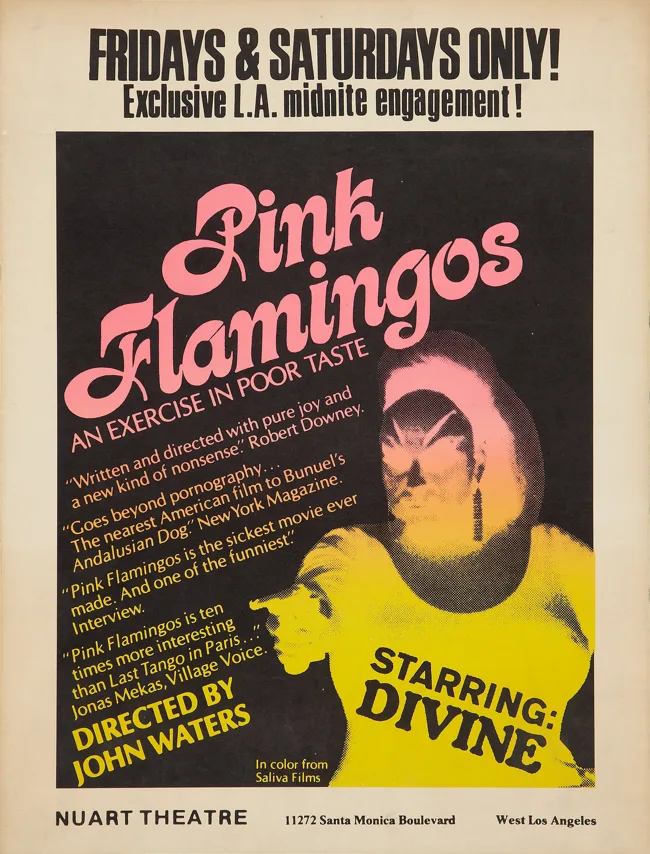
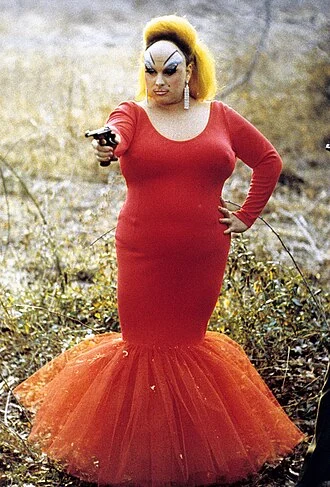
Pink Flamingos is a 1972 American independent black comedy crime film by John Waters. It is part of what Waters has labelled the "Trash Trilogy", which also includes Female Trouble (1974) and Desperate Living (1977). The film stars the countercultural drag queen and actor Divine as a criminal living under the name of Babs Johnson, who is proud to be "the filthiest person alive". While living in a trailer with her mother Edie (Edith Massey), son Crackers (Danny Mills), and companion Cotton (Mary Vivian Pearce), Divine is confronted by the Marbles (David Lochary and Mink Stole), a pair of criminals envious of her reputation who try to outdo her in filth. Characters caught in their feud include the Marbles’ sadistic butler Channing (Channing Wilroy), their spy Cookie (Cookie Mueller), and The Egg Man (Paul Swift), an egg salesman whom Edie is infatuated with. The characters engage in several grotesque, bizarre, and explicitly crude situations, and upon the film's re-release in 1997, it was rated NC-17 by the MPAA "for a wide range of perversions in explicit detail". It was filmed in the vicinity of Baltimore, Maryland, where Waters and most of the cast and crew grew up. Displaying the tagline "An exercise in poor taste", Pink Flamingos is notorious for its "outrageousness", nudity, profanity, and "pursuit of frivolity, scatology, sensationology [sic] and skewed epistemology". It features a "number of increasingly revolting scenes" that center on exhibitionism, voyeurism, sodomy, masturbation, gluttony, vomiting, rape, incest, murder, animal cruelty, cannibalism, zoophilia, castration, foot fetishism, and concludes, to the accompaniment of "How Much Is That Doggy in the Window?", with Divine's consumption of dog feces – "The real thing!" narrator Waters assures the viewers. The film is considered a preliminary exponent of abject art. The film, at first semi-clandestine, has received a warm reception from film critics and, despite being banned in several countries and even in some parts of the United States, became a cult film in the 1980s and 1990s. In 2021, the film was selected for preservation in the United States National Film Registry by the Library of Congress as being "culturally, historically, or aesthetically significant".
From Wikipedia contributors · CC BY-SACast & filmmakers

Cast and characters
- David Lochary
- Raymond Marble
- Danny Mills
- Crackers
- Edith Massey
- Edie
- Channing Wilroy
- Channing
- Cookie Mueller
- Cookie
- Paul Swift
- The Egg Man
- Susan Walsh
- Suzie
- Linda Olgeirson
- Linda
- Pat Moran
- Patty Hitler
- Jack Walsh
- Party Guest
- Bob Skidmore
- Delivery Boy
- Pat Lefaiver
- First Lesbian
- John Waters
- Mr. J
- Mary Vivian Pearce
- Cotton
Behind the film
Storyline (spoilers)
Notorious criminal Divine lives under the pseudonym "Babs Johnson" with her mother Edie, delinquent son Crackers, and traveling companion Cotton. They share a trailer on the outskirts of Phoenix, Maryland, next to a gazing ball and a pair of plastic pink flamingos. After learning that Divine has been dubbed "the filthiest person alive" by a tabloid paper, jealous rivals Connie and Raymond Marble attempt to usurp her title.
Development
Divine's friend Bob Adams described the trailer set as a "hippie commune" in Phoenix, Maryland, and noted that their living quarters were in a farmhouse without hot water. Adams added that ultimately Divine and Van Smith decided to sleep at Susan Lowe's home in Baltimore, and that they would awake before dawn to apply Divine's makeup before being driven to the set by Jack Walsh. "Sometimes Divy would have to wait out in full drag for Jack to pull the car around from back, and cars full of these blue-collar types on their way to work would practically mount the pavement from gawking at him," Adams said.
Filming
Principal photography began October 1, 1971 and ended January 12, 1972. Shot on a budget of only $12,000, Pink Flamingos is an example of Waters' style of low-budget filmmaking inspired by New York underground filmmakers like Kenneth Anger, Andy Warhol, and brothers Mike and George Kuchar. Stylistically, it takes its cues from "exaggerated seaport ballroom drag-show pageantry and antics" with "classic '50s rock-and-roll kitsch classics". Waters' idiosyncratic style also characterized by its "homemade Technicolor" look, the result of high amounts of indoor paint and make-up was dubbed the "Baltimore aesthetic" by art students at Providence.
Directed by
Written by
Cast
Title details
- Release year
- 1972
- Release date
- 1972-03-17
- Runtime
- 93 min
- Production companies
- Dreamlanders
- Distributors
- Netflix, New Line Cinema
- Genres
- Comedy
- Language
- English
- Country of origin
- United States of America