Overview
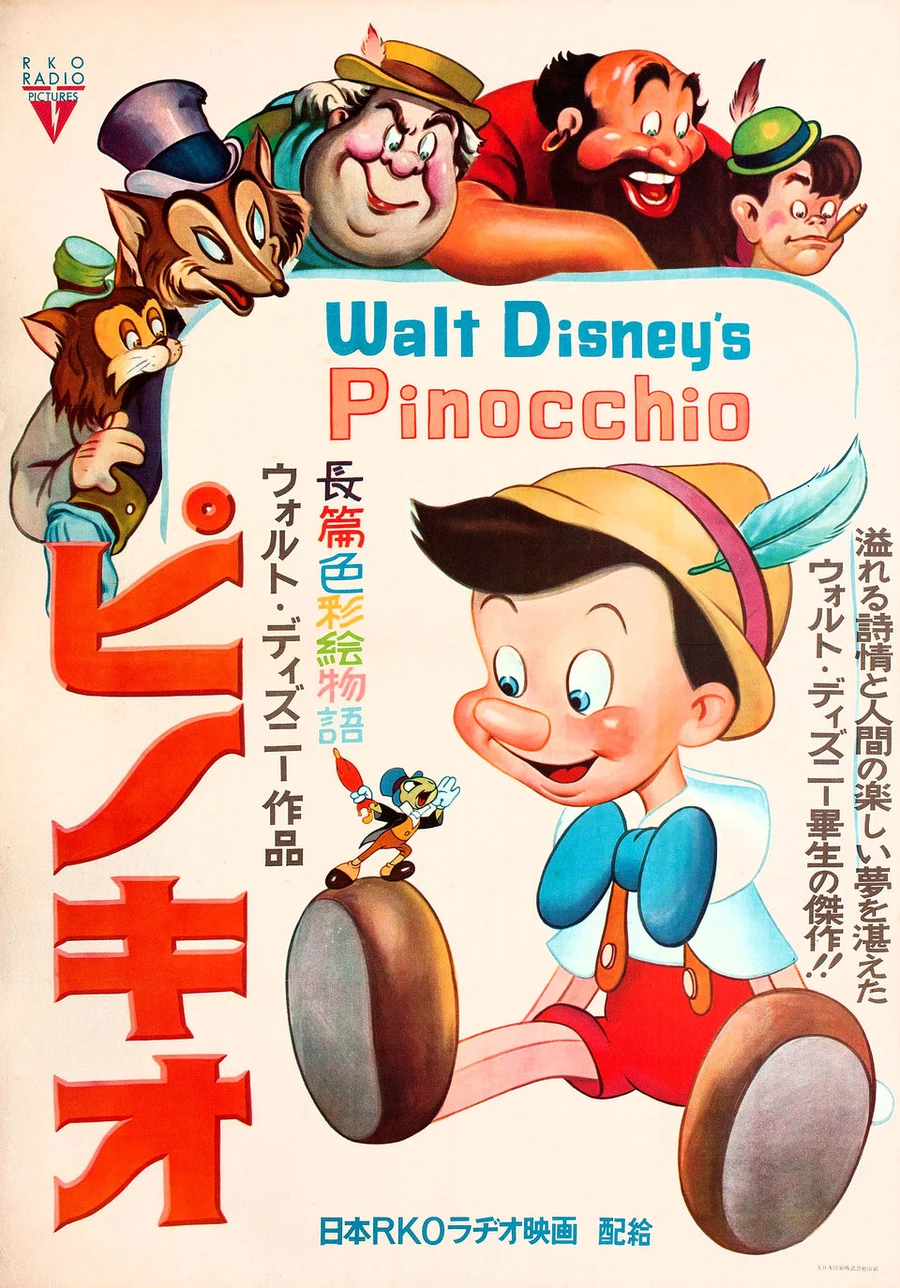
Pinocchio is a 1940 American animated musical fantasy film produced by Walt Disney Productions and released by RKO Radio Pictures. Based on Carlo Collodi's 1883 children's novel The Adventures of Pinocchio, it is the second Disney animated feature film, made after the first animated success Snow White and the Seven Dwarfs (1937).
From Wikipedia contributors · CC BY-SACast and characters
- Dickie Jones
- Pinocchio
- Cliff Edwards
- Jiminy Cricket
- Christian Rub
- Geppetto
- Clarence Nash
- Figaro
- Walter Catlett
- "Honest" John Worthington Foulfellow
- Mel Blanc
- Gideon the Cat
Behind the film
Storyline (spoilers)
In a sleepy village in Italy, Jiminy Cricket arrives at the shop of a woodworker and toymaker named Geppetto, who creates a puppet he names Pinocchio. As he falls asleep, Geppetto wishes upon a star for Pinocchio to be a real boy. Late that night, the Blue Fairy visits the workshop and brings Pinocchio to life, although he remains a puppet. She informs him that if he proves himself to be brave, truthful, and unselfish, he will become a real boy. When Jiminy reveals himself, the Blue Fairy assigns him to be Pinocchio's conscience. Geppetto awakens upon hearing the commotion from Pinocchio falling, and is overjoyed to discover that he is alive and will become a real boy.
Development
In September 1937, during the production of Snow White and the Seven Dwarfs, animator Norman Ferguson brought a translated version of Carlo Collodi's 1883 Italian children's novel The Adventures of Pinocchio to the attention of Walt Disney. After reading the book, "Walt was busting his guts with enthusiasm," as Ferguson later recalled. Disney then commissioned storyboard artist Bianca Majolie to write a new story outline for the book, but after reading it, he felt her outline was too faithful. Pinocchio was intended to be the studio's third feature, after Bambi (1942). However, due to difficulties with Bambi (adapting the story and animating the animals realistically), Disney announced that Bambi would be postponed while Pinocchio would move ahead in production. Ben Sharpsteen was then re-assigned to supervise the production while Jack Kinney was given directional reins.
Box office
At first, Pinocchio was not a box-office success. The box office returns from the film's initial release were both below Snow White's unprecedented success and below studio expectations. Of the film's $2.6 million negative cost—twice the cost of Snow White—Disney only recouped $1 million by late 1940, with studio reports of the film's final original box office take varying between $1.4 million and $1.9 million. Animation historian Michael Barrier notes that Pinocchio returned rentals of less than one million by September 1940, and in its first public annual report, Walt Disney Productions charged off a $1 million loss to the film. Barrier relays that a 1947 Pinocchio balance sheet listed total receipts to the studio of $1.4 million.
Awards
The film was nominated and won two Academy Awards in 1940 for Best Original Score and Best Original Song (for "When You Wish Upon a Star"), the first Disney film to win either category. To date, only six other Disney films have made this achievement: Mary Poppins (1964), The Little Mermaid (1989), Beauty and the Beast (1991), Aladdin (1992), The Lion King (1994), and Pocahontas (1995).
Directed by
Cast
Title details
- Release year
- 1940
- Runtime
- 88 min
- Film series
- Walt Disney Animation Studios feature film
- Based on
- The Adventures of Pinocchio
- Distributors
- Disney+, RKO Pictures
- Content rating
- G
- Genres
- Animated, Fantasy, Musical
Awards and nominations
Awards received (1)
- Academy Award for Best Original Score
Nominations (1)
- Academy Award for Best Original Score