Overview
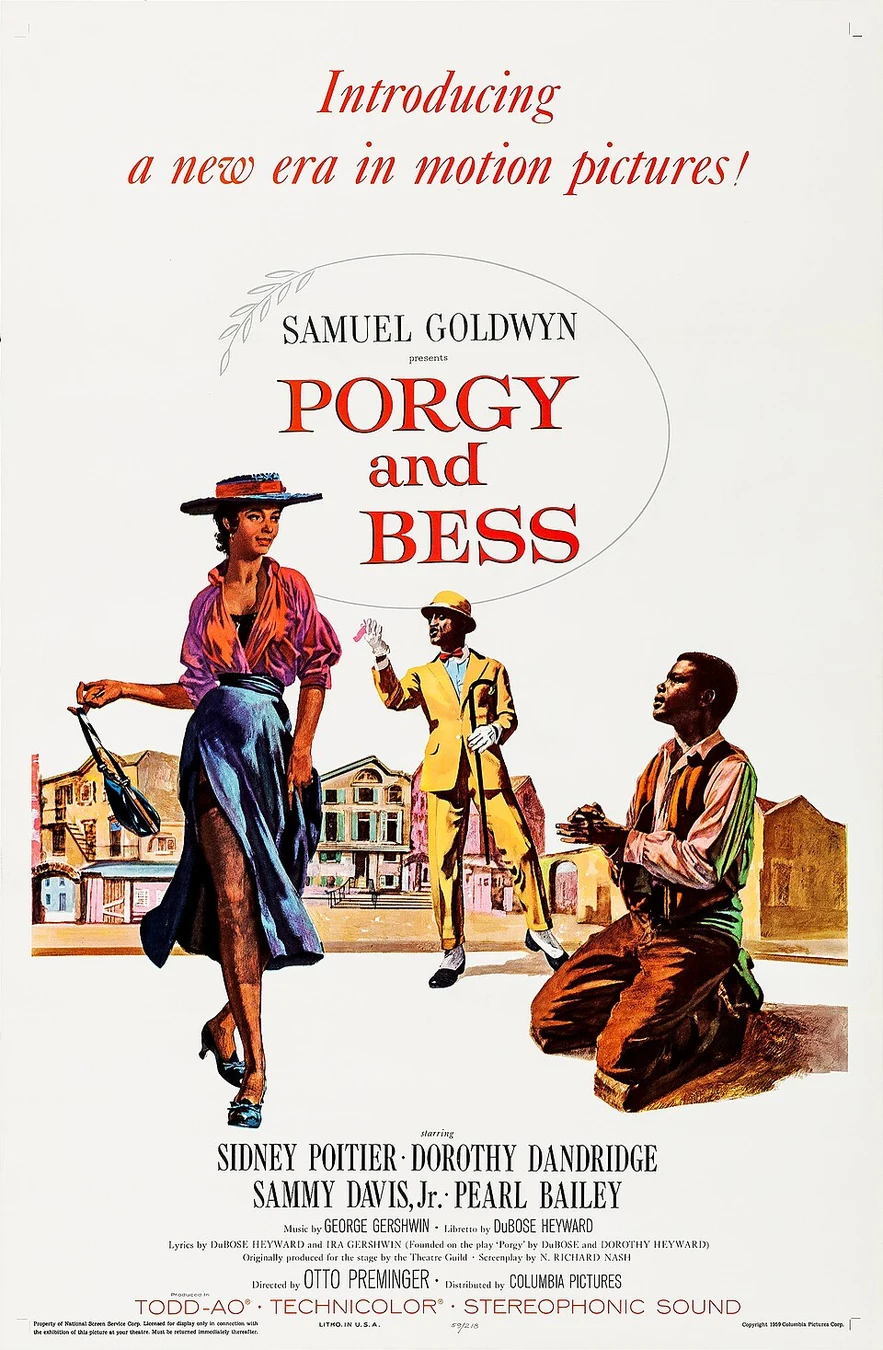
Porgy and Bess is a 1959 American musical drama film directed by Otto Preminger, and starring Sidney Poitier and Dorothy Dandridge in the titular roles. It is based on the 1935 opera Porgy and Bess by George Gershwin, DuBose Heyward and Ira Gershwin, in turn based on Heyward's 1925 novel Porgy, as well as Heyward's subsequent 1927 non-musical stage adaptation, co-written with his wife Dorothy. The film's screenplay, which turned the operatic recitatives into spoken dialogue, was very closely based on the opera and was written by N. Richard Nash. In 2011, the film was chosen for preservation in the National Film Registry of the Library of Congress. The project was the last for Samuel Goldwyn. Due to its controversial subject matter, the film was shown only briefly following its initial reserved seat engagements in major cities, where it drew mixed reviews from critics. Two months after its release, Goldwyn grudgingly conceded, "No one is waiting breathlessly for my next picture." The film was unavailable on home video for years, and has been described as the "Holy Grail of "lost films." One of the few complete copies of the film was shown in 2007, 2010, 2019,and 2026.
From Wikipedia contributors · CC BY-SACast
Behind the film
Storyline (spoilers)
Set in the early 1900s in the fictional Catfish Row section of Charleston, South Carolina, which serves as home to a black fishing community, the story focuses on the title characters: crippled beggar Porgy, who travels about in a goat-drawn cart, and the drug-addicted Bess, who lives with stevedore Crown, the local bully. While high on cocaine supplied by Sportin' Life, Crown kills Robbins after the latter vanquishes him in a craps game; Bess urges Crown to flee. Sportin' Life suggests she accompany him to New York City, an offer Bess declines. She seeks refuge with her neighbors, all of whom refuse to help her. Porgy finally agrees to let her stay with him.
Development
The original 1935 Broadway production of Porgy and Bess closed after only 124 performances. A 1942 revival, stripped of all recitative, fared slightly better, as did a subsequent national tour and another revival in 1953, but in financial terms, the work did not have a very good track record. Still, there were many who thought it had potential as a film. Otto Preminger was one of several producers, including Hal B. Wallis, Louis B. Mayer, Dore Schary, Anatole Litvak, Joseph L. Mankiewicz and Harry Cohn, who had tried to secure the film rights without success. Cohn even wanted to cast Fred Astaire, Al Jolson and Rita Hayworth, and have them perform in blackface, something to which the Gershwin estate vehemently opposed. For 25 years, Ira Gershwin had resisted all offers, certain that his brother's work would be "debased" by Hollywood.
Filming
A full-cast dress rehearsal was scheduled for July 3, 1958, but slightly after 4:00 am, a fire destroyed all of the sets and costumes, at a loss of $2 million. Rumors that the blaze had been started by Black arsonists determined to shut down production immediately began to circulate. Goldwyn publicly denounced this rumor, although studio insiders were certain that the fire had been set deliberately. The production was placed on hiatus for six weeks to allow for reconstruction. During this period, director Mamoulian repeatedly clashed with the producer about every aspect of the film, leading Goldwyn to fire him. William Wyler was willing to step in if Goldwyn could postpone a few months, but the producer opted to replace Mamoulian with Otto Preminger, who had already started preparing both Anatomy of a Murder (1959) and Exodus (1960), but was willing to set them aside for the opportunity to helm Porgy and Bess.
Awards
In 2011, Porgy and Bess was deemed "culturally, historically, or aesthetically significant" by the United States Library of Congress and selected for preservation in the National Film Registry. The Registry noted the film's production history, a period when "the civil rights movement gained momentum and a number of African-American actors turned down roles they considered demeaning", but that, over time, it was "now considered an 'overlooked masterpiece' by one contemporary scholar".
Directed by
Title details
- Release year
- 1959
- Runtime
- 138 min
- Distributors
- Columbia Pictures, Netflix
- Genres
- Musical, Drama
Awards and nominations
Awards received (1)
- Academy Award for Best Original Musical Score
Nominations (4)
- Academy Award for Best Cinematography, Color
- Academy Award for Best Costume Design, Color
- Academy Award for Best Original Musical Score
- Academy Award for Best Sound