Overview
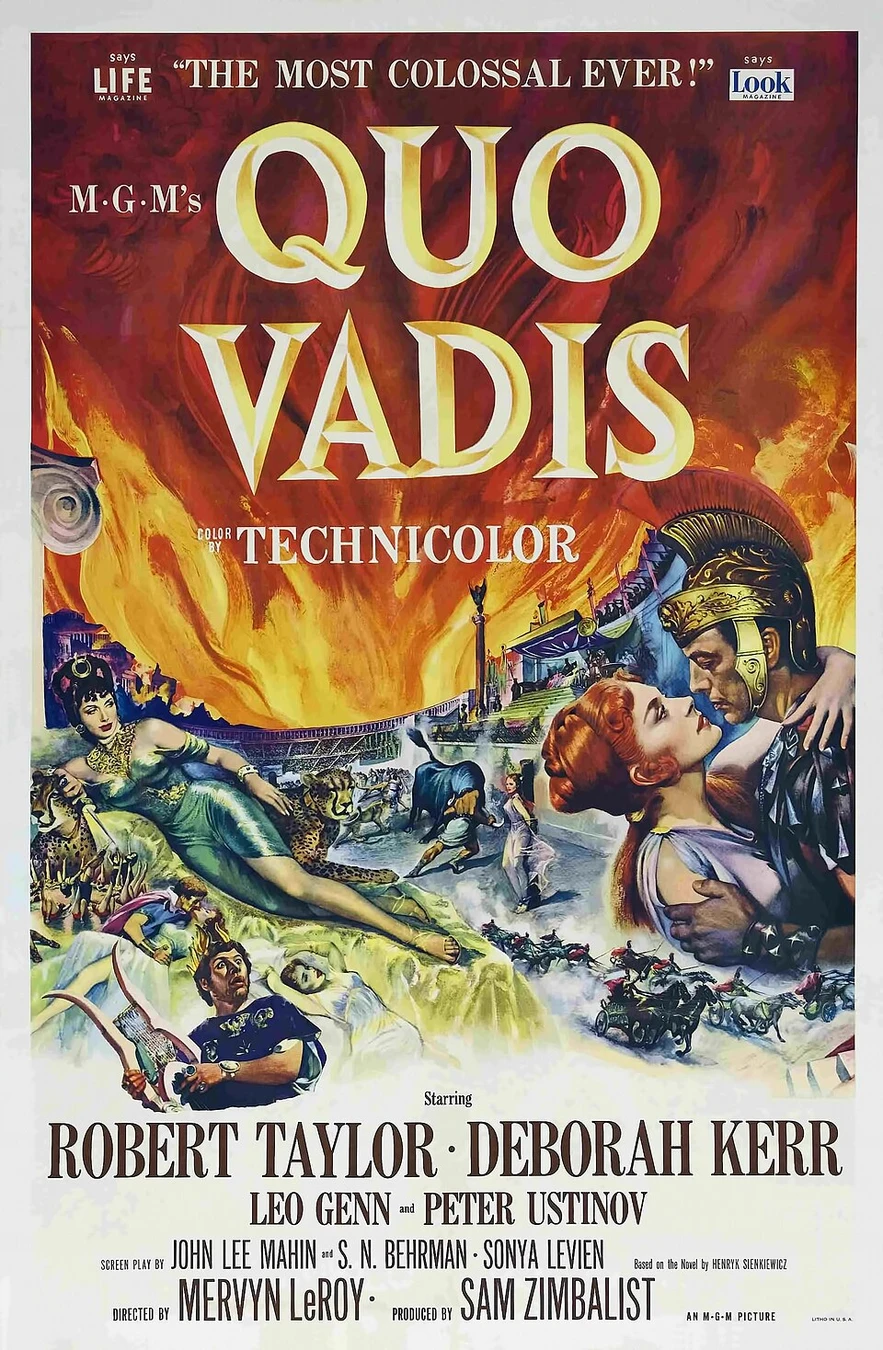
Quo Vadis (Latin for "Where are you going?") is a 1951 American religious epic historical film set in ancient Rome during the final years of Emperor Nero's reign, based on the 1896 novel of the same title by Polish Nobel Laureate author Henryk Sienkiewicz. Produced by Metro-Goldwyn-Mayer and filmed in Technicolor, it was directed by Mervyn LeRoy from a screenplay by S. N. Behrman, Sonya Levien, and John Lee Mahin. It is the fourth screen adaptation of Sienkiewicz's novel. The film stars Robert Taylor, Deborah Kerr, Leo Genn, and Peter Ustinov, and features Patricia Laffan, Finlay Currie, Abraham Sofaer, Marina Berti, Buddy Baer, and Felix Aylmer. Future Italian stars Sophia Loren and Bud Spencer appeared as uncredited extras. The score is by Miklós Rózsa and the cinematography by Robert Surtees and William V. Skall. The film was released by Metro-Goldwyn-Mayer on November 2, 1951. The story, set between 64 and 68 AD, combines both historical and fictional events and characters, and compresses the key events of that period into the space of only a few weeks. Its main theme is the Roman Empire’s conflict with Christianity and the persecution of Christians in the final years of the Julio-Claudian line. Unlike his illustrious and powerful predecessor, Emperor Claudius, Nero proved corrupt and destructive, and his actions eventually threatened to destroy Rome's previously peaceful social order. The title refers to an incident in the apocryphal Acts of Peter. The film was nominated for eight Academy Awards, including Best Picture, and it was such a huge box office success that it was credited with single-handedly rescuing MGM from the brink of bankruptcy. Peter Ustinov won the Golden Globe Award for Best Supporting Actor – Motion Picture, and Robert Surtees and William V. Skall won the award for Best Cinematography.
From Wikipedia contributors · CC BY-SACast
Behind the film
Storyline (spoilers)
Marcus Vinicius is a Roman military commander and the legate of the XIV Gemina. Returning from wars in Britain and Gaul, he stays in the house of Aulus Plautius, a retired Roman general, and becomes smitten with Lygia, a Lygian hostage of Rome in the old general's care. Unbeknownst to Marcus, Lygia, Aulus, and his household are devout Christians, who host Paul the Apostle that very night. Petronius, Marcus' uncle, persuades Nero to give the girl to his nephew as a reward for his services. Lygia resents this arrangement, but eventually falls in love with Marcus.
Filming
Produced for $7 million, it was the most expensive film ever made at the time. It became MGM's largest grosser since Gone with the Wind (1939). Filmed at the sprawling Cinecitta Studios that had been opened by Benito Mussolini in 1937 as part of the dictator's master plan to make Rome the pre-eminent world capital. (Mussolini's son Vittorio Mussolini and Hollywood producer Hal Roach negotiated to form the R.A.M. ["Roach and Mussolini"] Corporation later in 1937, which was ultimately aborted. This business alliance with the Fascist state horrified 1930s Hollywood moguls and ultimately led to Roach defecting from his MGM distribution deal to United Artists in 1938.)
Directed by
Title details
- Release year
- 1951
- Runtime
- 171 min
- Based on
- Quo Vadis
- Distributors
- Metro-Goldwyn-Mayer, Netflix
- Content rating
- G
- Genres
- Historical
Awards and nominations
Awards received (1)
- National Board of Review: Top Ten Films
Nominations (7)
- Academy Award for Best Art Direction, Color
- Academy Award for Best Cinematography, Color
- Academy Award for Best Costume Design, Color
- Academy Award for Best Film Editing
- Academy Award for Best Original Dramatic or Comedy Score
- Academy Award for Best Picture
- Academy Award for Best Supporting Actor


 Trailer still