Overview
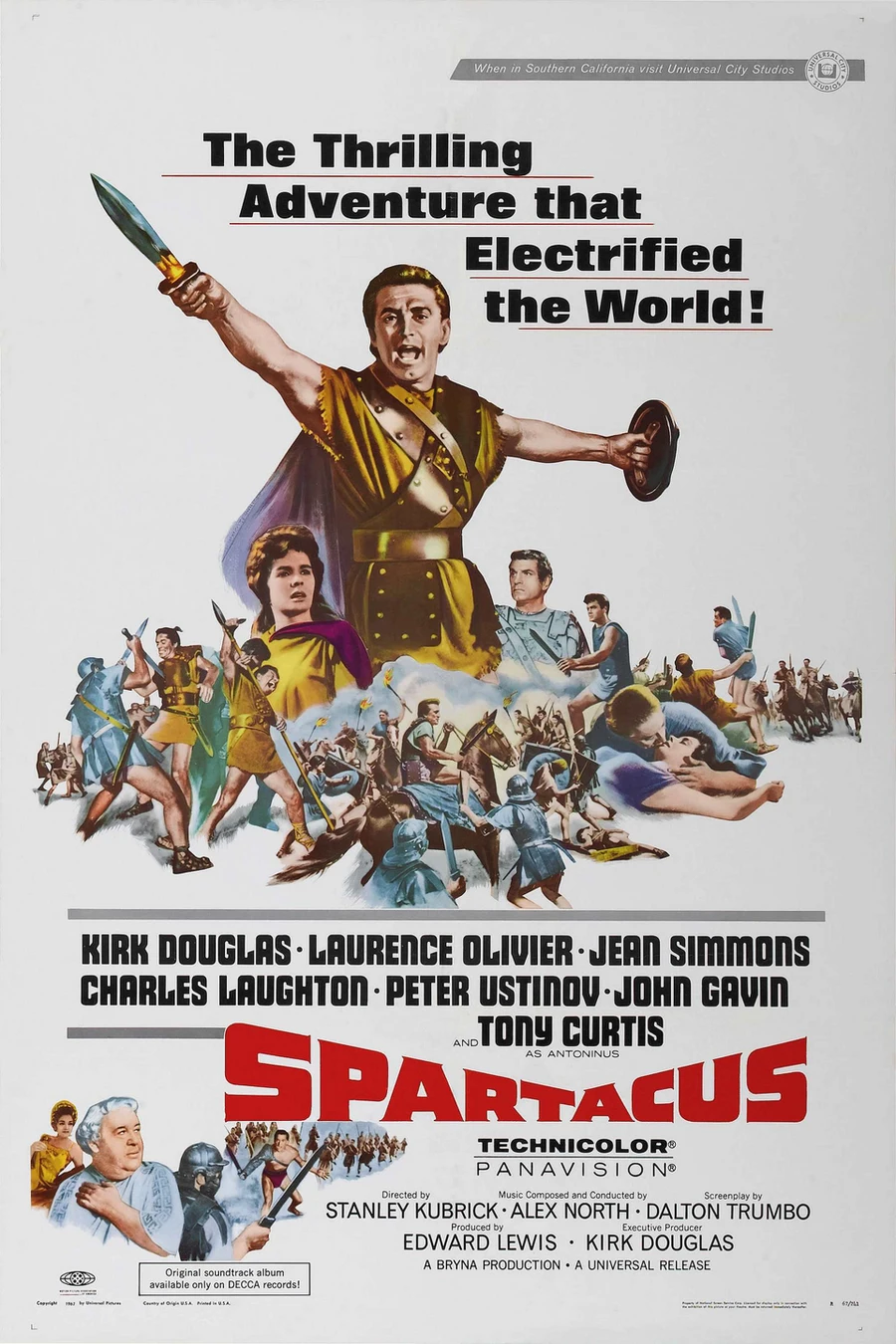
Spartacus is a 1960 American epic historical drama film directed by Stanley Kubrick and starring Kirk Douglas as Spartacus, a slave and gladiator who leads a rebellion against Rome during the events of the Third Servile War. Adapted by Dalton Trumbo from Howard Fast's 1951 novel of the same title, the film also stars Laurence Olivier as Roman general and politician Marcus Licinius Crassus, Charles Laughton as rival senator Sempronius Gracchus, Peter Ustinov as gladiatorial school owner Lentulus Batiatus, and John Gavin as Julius Caesar. Jean Simmons played Spartacus' wife Varinia, a fictional character, and Tony Curtis played the fictional slave Antoninus. Douglas, whose company Bryna Productions was producing the film, removed original director Anthony Mann after three weeks of shooting. Kubrick, with whom Douglas had made Paths of Glory (1957), took over as director. It was the only film directed by Kubrick where he did not have complete artistic control. Screenwriter Dalton Trumbo was blacklisted at the time as one of the Hollywood Ten. Douglas publicly announced that Trumbo was the screenwriter of Spartacus, and President John F. Kennedy crossed American Legion picket lines to view the film, helping to end blacklisting; Howard Fast's book had also been blacklisted and he had to self-publish the original edition. The film won four Academy Awards (Best Supporting Actor for Ustinov, Best Cinematography, Best Art Direction and Best Costume Design) from six nominations. It also received six nominations at the Golden Globes, including Woody Strode’s only career Golden Globe nomination (for Best Supporting Actor), ultimately winning one (Best Motion Picture – Drama). At the time of the film’s release, it was the highest grossing film in Universal Studios' history, which it remained until it was surpassed by Airport (1970). In 2017, it was selected for preservation in the United States National Film Registry by the Library of Congress as being "culturally, historically, or aesthetically significant."
From Wikipedia contributors · CC BY-SACast
Behind the film
Storyline (spoilers)
In the first century BC, the Roman Republic has slid into corruption, its menial work done by slaves. One slave, a Thracian named Spartacus, is so uncooperative in his position in a mining pit that he is sentenced to death by starvation. By chance, he is displayed to Roman lanista (gladiatorial school manager) Lentulus Batiatus, who – impressed by his ferocity – purchases Spartacus for his school in Capua and instructs trainer Marcellus not to overdo his indoctrination, believing the slave "has quality". Amid the abuse, Spartacus forms a quiet relationship with Varinia, a serving woman whom he refuses to touch when she is sent to "entertain" him in his cell. The two are forced to endure numerous humiliations for defying the conditions of servitude.
Development
The development of Spartacus was partly instigated by Kirk Douglas' failure to win the title role in William Wyler's Ben-Hur (1959). Douglas had worked with Wyler before on Detective Story (1951), and was disappointed when Wyler chose Charlton Heston, instead. Shortly after, Edward Lewis, a vice president for Douglas's film company, Bryna Productions (named after Douglas's mother), had read Howard Fast's novel, Spartacus, which had a related theme—an individual who challenges the might of the Roman Empire. Douglas was impressed enough to purchase an option on the book with his own finances. He proposed the project to Arthur B. Krim, the head of United Artists, which was set to distribute The Vikings (1958), which also starred Douglas. Krim turned down the project as Yul Brynner had been developing his own Spartacus film, tentatively titled The Gladiators.
Filming
David Lean was offered but turned down an offer to direct Spartacus. Anthony Mann, best known for his Westerns which included Winchester '73 (1950) and The Naked Spur (1953), was instead hired. Filming started on January 27, 1959, in Death Valley, California for the opening sequence in the quarry. As filming continued, Douglas felt Mann had lost control of the film, writing in particular: "He seemed scared of the scope of the picture ... He let Peter Ustinov direct his own scenes by taking every suggestion Peter made. The suggestions were good—for Peter, but not necessarily for the film." On February 13, Mann left (or was fired from) the production. Mann did not discuss the reasons for his departure until shortly before his death in 1967, in which he stated: "Kirk Douglas was the producer of Spartacus: he wanted to insist on the message angle.
Box office
Spartacus was a commercial success upon its release and became the highest-grossing film of 1960. In its first year from 304 dates (including 116 in 25 countries outside the US and Canada), it had grossed $17 million, including nearly $1.5 million from more than half a million admissions in over a year at the DeMille Theatre. By January 1963, the film had earned theatrical rentals of $14 million in the United States and Canada. The 1967 re-release increased its North American rentals to $14.6 million.
Directed by
Title details
- Release year
- 1960
- Based on
- Spartacus
- Distributors
- Netflix, Universal Pictures
- Genres
- Drama, Historical
Awards and nominations
Awards received (5)
- Academy Award for Best Art Direction, Color
- Academy Award for Best Cinematography, Color
- Academy Award for Best Costume Design, Color
- Academy Award for Best Supporting Actor
- Golden Globe Award for Best Motion Picture – Drama
Nominations (14)
- Academy Award for Best Art Direction, Color
- Academy Award for Best Cinematography, Color
- Academy Award for Best Costume Design
- Academy Award for Best Costume Design, Color
- Academy Award for Best Film Editing
- Academy Award for Best Original Dramatic or Comedy Score
- Academy Award for Best Production Design
- Academy Award for Best Supporting Actor
- BAFTA Award for Best Film
- Golden Globe Award for Best Actor – Motion Picture Drama
- Golden Globe Award for Best Director
- Golden Globe Award for Best Motion Picture – Drama
- Golden Globe Award for Best Original Score
- Golden Globe Award for Best Supporting Actor – Motion Picture