Overview
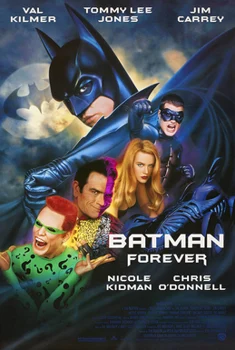
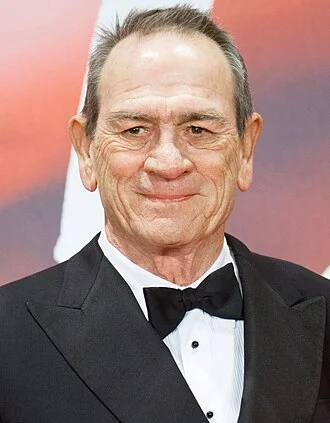
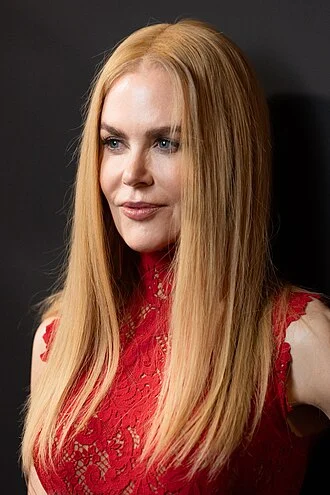
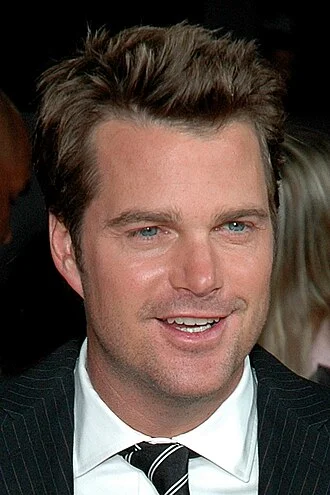
Batman Forever is a 1995 American superhero film based on the DC Comics character Batman. It is the sequel to Batman Returns and the third installment in the Batman film series (1989–1997). Directed by Joel Schumacher and produced by Tim Burton and Peter MacGregor-Scott, it stars Val Kilmer as Bruce Wayne / Batman, replacing Michael Keaton, alongside Tommy Lee Jones, Jim Carrey, Nicole Kidman, and Chris O'Donnell. The film follows Batman as he attempts to prevent Two-Face (Jones) and the Riddler (Carrey) from uncovering his secret identity and extracting information from the minds of Gotham City's residents, while at the same time navigating his feelings for psychologist Dr. Chase Meridian (Kidman) and adopting orphaned acrobat Dick Grayson (O'Donnell)—who becomes his partner and best friend, Robin. Schumacher mostly eschewed the dark, dystopian atmosphere of Burton's films by drawing inspiration from the Batman comic books of the Dick Sprang era, as well as the 1960s television series. After Keaton chose not to reprise his role, William Baldwin and Ethan Hawke were considered as replacements, before Kilmer joined the cast. Batman Forever was released by Warner Bros. on June 16, 1995, to mixed reviews from critics, who praised the visuals, action sequences, and soundtrack, but criticized the screenplay and tonal departure from the previous two films. The film was a box office success, grossing over $336 million worldwide and becoming the sixth-highest-grossing film of 1995. It was followed by Batman & Robin in 1997, with Schumacher returning as the director, O'Donnell returning as Robin, and George Clooney replacing Kilmer as Batman.
From Wikipedia contributors · CC BY-SACast & filmmakers
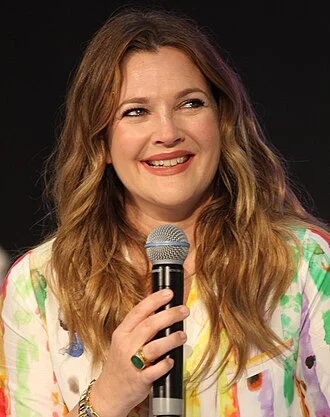
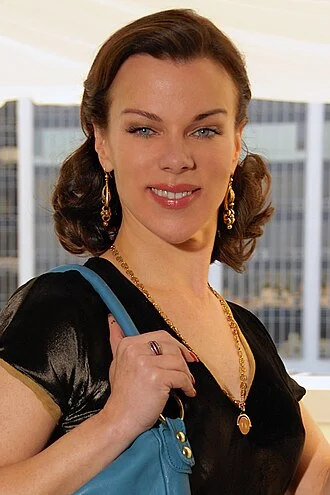
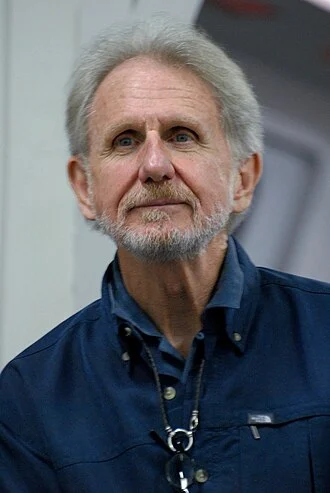
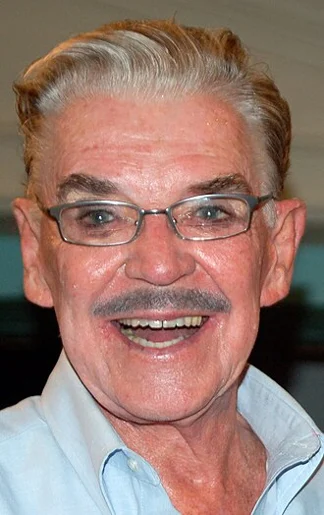
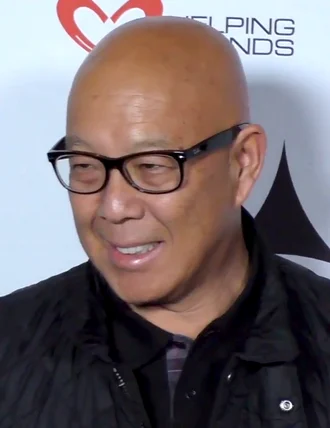
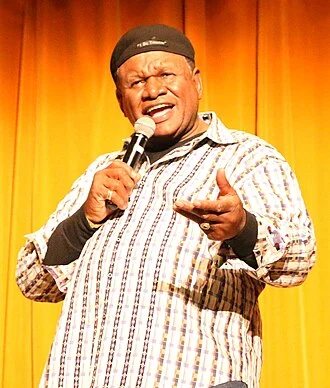
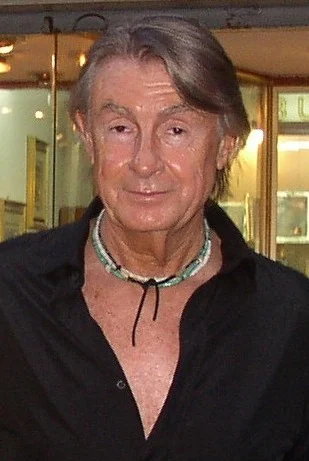
Cast and characters
- Elizabeth Sanders
- Gossip Gerty
- Glory Fioramonti
- Mary Grayson
- Mitch Gaylord
- Mitch Grayson
- Ofer Samra
- Harvey's thug
Film poster
Batman's sweeping cape divides a blue portrait from the villains' hot green and orange costumes.
Poster source · Vybpedia article · Film publicity artworkBehind the film
Storyline (spoilers)
In Gotham City, Batman defuses a hostage situation orchestrated by the criminal Two-Face, formerly district attorney Harvey Dent, who escapes. Flashbacks reveal that Dent, once one of Batman's biggest supporters, was horribly disfigured with acid on one side of his face by mobster Sal Maroni. The trauma of the incident caused Dent to develop a split personality, make decisions based on the flip of a coin, and swear vengeance against Batman for failing to prevent the incident.
Development
Batman Returns was released in 1992 with financial success and generally favorable reviews from critics, but Warner Bros. was disappointed with its box office run, having made $150 million less than the first film. After Batman Returns was deemed too dark and inappropriate for children, with McDonald's even recalling their Happy Meal tie-in, Warner Bros. decided that this was the primary cause of the film's financial results. After the film's release, Warner Bros. was not interested in Tim Burton's return as director. Burton noted he was unsure about returning to direct, writing: "I don't think Warner Bros. wanted me to direct a third Batman. I even said that to them." Burton and Warner Bros. mutually agreed to part ways, though Burton would stay on as producer. John McTiernan turned down an offer to direct since he was too busy making Die Hard with a Vengeance (1995). In June 1993, Joel Schumacher was selected by Warner Bros.
Filming
Principal photography began on September 24, 1994, and wrapped on March 5, 1995. Schumacher hired Barbara Ling for production design, claiming that the film needed a "force" and good design. Ling could "advance on it". Schumacher wanted a design in no way connected to the previous films, and instead inspired by the images from the Batman comic books seen in the 1940s and early 1950s, and New York City architecture in the 1930s, with a combination of modern Tokyo. He also wanted a "city with personality," with more statues, as well as various amounts of neon.
Box office
Batman Forever opened in a record 2,842 theaters and 4,300 screens in the United States and Canada on June 16, 1995, grossing $52.8 million in its opening weekend, For six years, it had the largest opening weekend for a Warner Bros. film until 2001, when it was surpassed by Harry Potter and the Sorcerer's Stone. The film also achieved the highest June opening weekend, holding that record until it was beaten by Austin Powers: The Spy Who Shagged Me in 1999. It was the first film to gross $20 million in one day, on its opening day on Friday. The film also beat out Congo to reach the number one spot.
Awards
At the 68th Academy Awards, Batman Forever was nominated for Cinematography (lost to Braveheart), Sound (Donald O. Mitchell, Frank A. Montaño, Michael Herbick and Petur Hliddal; lost to Apollo 13) and Sound Effects Editing (John Leveque and Bruce Stambler; also lost to Braveheart).
Directed by
Written by
Cast
Title details
- Release year
- 1995
- Release date
- 1995-06-09
- Runtime
- 121 min
- Film series
- Batman, Batman in film
- Based on
- Batman
- Production companies
- PolyGram Filmed Entertainment, Tim Burton Productions, Warner Bros. Entertainment
- Distributors
- InterCom, Netflix, Warner Bros. Entertainment
- Content rating
- PG-13
- Genres
- Superhero
- Language
- English
- Country of origin
- United States of America, United Kingdom
- Netflix reported views
- 500,000 · Batman Forever · 2026 H1
- Title in Brazil
- BATMAN ETERNAMENTE
- Brazil theatrical release
- 2025-09-20
- Brazilian film certificate
- E1500332300000
- Distributor in Brazil
- Warner Bros. (South) Inc.
Awards and nominations
Nominations (4)
- Academy Award for Best Cinematography
- Academy Award for Best Sound
- Academy Award for Best Sound Editing
- Kids' Choice Award for Favorite Movie
 Trailer still