Overview
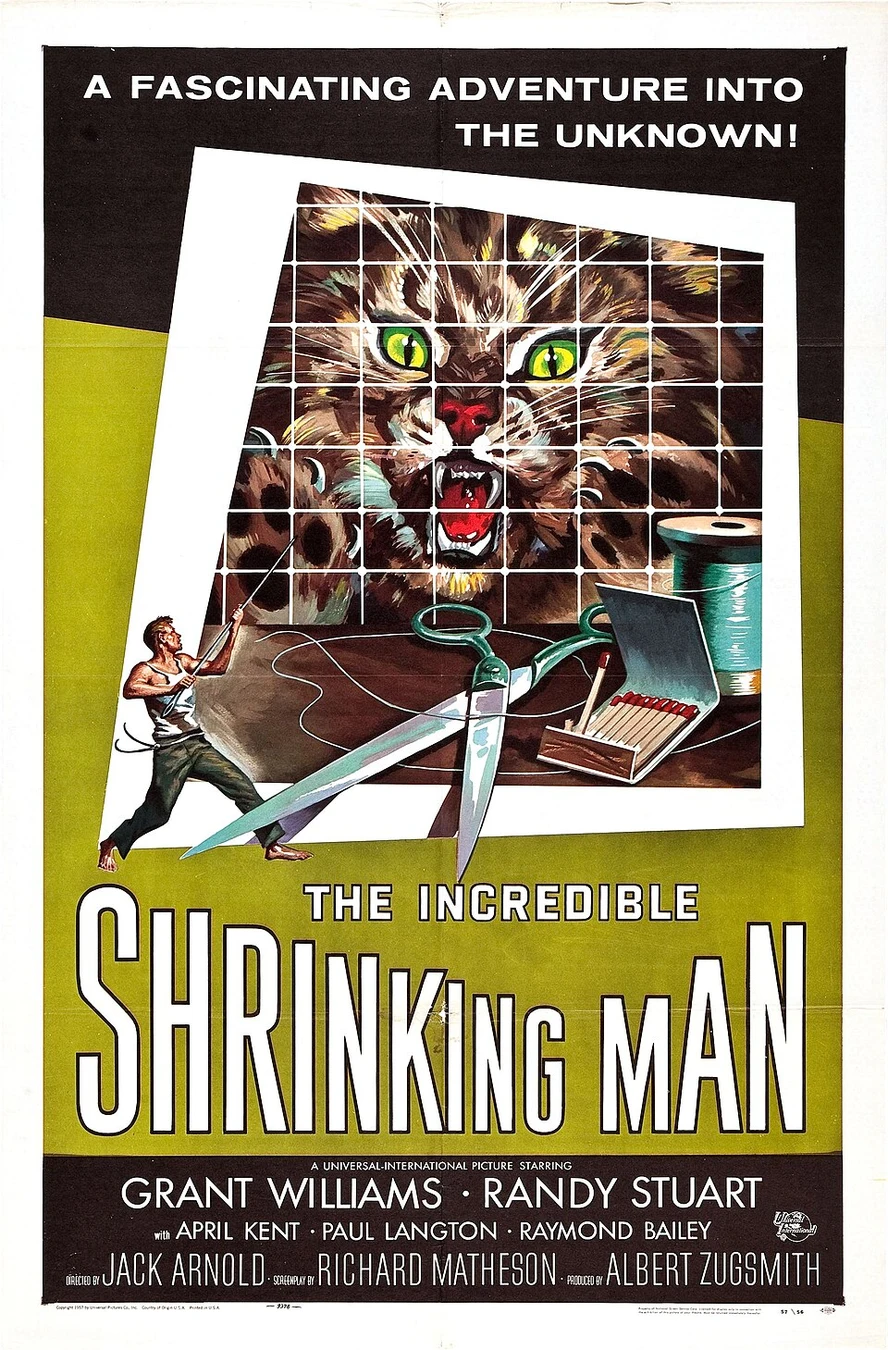
The Incredible Shrinking Man is a 1957 American science fiction film directed by Jack Arnold, based on Richard Matheson's 1956 novel, The Shrinking Man. The film stars Grant Williams as Scott and Randy Stuart as Scott's wife, Louise. While relaxing on a boat, Scott is enveloped by a strange fog. Months later, he discovers that he appears to be shrinking. By the time Scott has reached the height of a small boy, his condition becomes known to the public. When he learns there is no cure for his condition, he lashes out at his wife. As Scott shrinks to the point where he can fit into a dollhouse, he has a battle with his family cat, leaving him lost and alone in his basement, where he is now smaller than the average insect. The film's storyline was expanded by Matheson after he had sold the story to Universal-International Pictures Co., Inc. He also completed the novel upon which the film is based while production was underway. Matheson's script was initially written in flashbacks, and Richard Alan Simmons rewrote it using a more conventional narrative structure. Director Jack Arnold initially wanted Dan O'Herlihy to play Scott, but O'Herlihy turned down the role, leading Universal to sign Williams as the lead. Filming began on May 31, 1956. Scenes involving special effects were shot throughout production, while others used the large sets of Universal's backlot. Production went over budget, and filming had to be extended; certain special effects shots required reshooting. Williams was constantly being injured on set. Before the film's release in New York City on February 22, 1957, its ending first went to test audiences who felt the character's fate should be changed. The director's original ending remained in the film. The film grossed $1.43 million in the United States and Canada and was among the highest-grossing science fiction films of the 1950s. A sequel, The Fantastic Little Girl, originally penned by Matheson, never went into production. A remake was developed years later, eventually becoming the comedy The Incredible Shrinking Woman (1981). Other remakes were planned in the early 2000s, one of which was to star Eddie Murphy in a more comedic variation on the film. A new adaptation was announced in 2013, with Matheson writing the screenplay with his son Richard Christian Matheson. In 2009, the film was selected for preservation in the United States National Film Registry by the Library of Congress as being "culturally, historically, or aesthetically significant."
From Wikipedia contributors · CC BY-SACast
Behind the film
Storyline (spoilers)
Robert Scott Carey, known as "Scott," is on vacation with his wife, Louise, when a strange mist envelops him. Six months later, he observes that his clothes are too large, suspects he is shrinking, and seeks medical advice. Initially, his doctor denies that Carey is shrinking. Later, the doctor confirms the shrinking through X-rays and refers him to a medical research institute. The institute determines that Carey's exposure to the mist, combined with further exposure to a pesticide, rearranged his molecular structure, causing him to shrink. Carey informs Louise that, given his predicament, she is free to leave him. Louise promises to stay, and as she does, Carey's wedding ring slips off his finger.
Filming
On the first day of production, May 31, Universal's operating committee decided that because of the type of special photography involved in the making of the film, the publicity department would cooperate by publicizing a closed-door policy on the set. On-set photography would not be allowed while the film was shot to stimulate public and trade interest. Shooting took either five or six weeks, including the special effects sequences. The budget ranged between $700,000 and $800,000. Film critic Kim Newman said the budget was "not expensive", with most of it used for special effects.
Directed by
Title details
- Release year
- 1957
- Runtime
- 81 min
- Based on
- The Shrinking Man
- Distributors
- Universal Pictures
- Genres
- Science Fiction
Awards and nominations
Awards received (1)
- Hugo Award for Best Dramatic Presentation