Overview
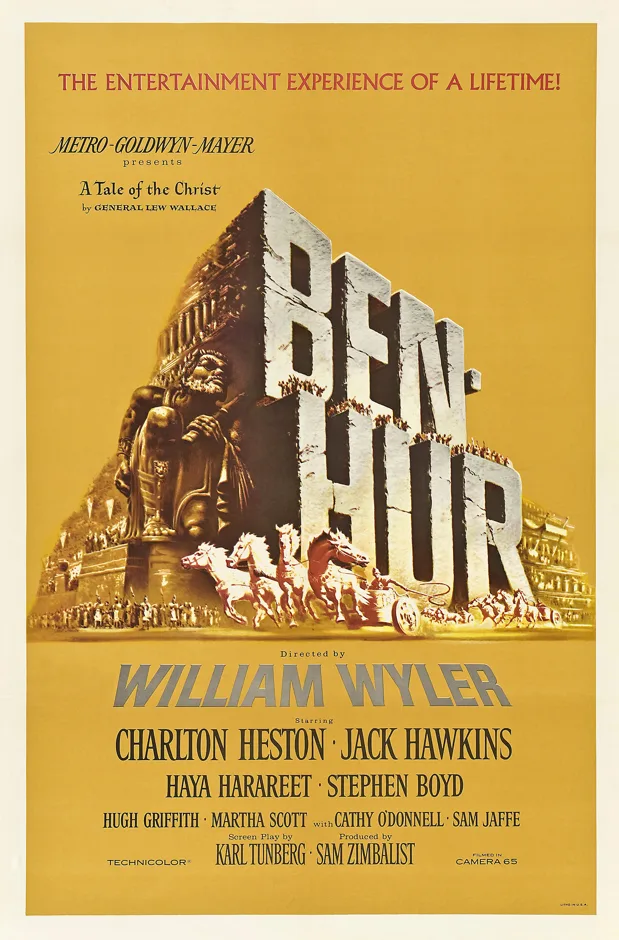
Ben-Hur () is a 1959 American religious epic film directed by William Wyler, produced by Sam Zimbalist, and starring Charlton Heston as the title character. A remake of the 1925 silent film with a similar title, it was adapted from Lew Wallace's 1880 novel Ben-Hur: A Tale of the Christ. The screenplay is credited to Karl Tunberg, but includes contributions from Maxwell Anderson, S. N. Behrman, Gore Vidal, and Christopher Fry. The cast also features Stephen Boyd, Jack Hawkins, Haya Harareet, Hugh Griffith, Martha Scott, Cathy O'Donnell and Sam Jaffe. Ben-Hur had the largest budget ($15.175 million), as well as the largest sets built, of any film produced at the time. Costume designer Elizabeth Haffenden oversaw a staff of 100 wardrobe fabricators to make the costumes, and a workshop employing 200 artists and workmen provided the hundreds of friezes and statues needed in the film. Filming commenced on May 18, 1958, and wrapped on January 7, 1959, with shooting lasting for 12 to 14 hours a day and six days a week. Pre-production began in Italy at Cinecittà around October 1957, and post-production took six months. Under cinematographer Robert L. Surtees, executives at Metro-Goldwyn-Mayer made the decision to produce the film in a widescreen format. Over 200 camels and 2,500 horses were used in the shooting of the film, with some 10,000 extras. The sea battle was filmed using miniatures in a huge tank on the back lot at the Metro-Goldwyn-Mayer Studios in Culver City, California. The nine-minute chariot race has become one of cinema's most famous action sequences, and the score, composed and conducted by Miklós Rózsa, was at the time the longest ever composed for a film, and was highly influential on cinema for over 15 years. Following a $14.7 million marketing effort, Ben-Hur premiered at Loew's State Theatre in New York City on November 18, 1959. It was the fastest-grossing as well as the highest-grossing film of 1959, becoming the second highest-grossing film in history at the time, after Gone with the Wind. It won a record eleven Academy Awards, including Best Picture, Best Director (Wyler), Best Actor in a Leading Role (Heston), Best Actor in a Supporting Role (Griffith), and Best Cinematography – Color (Surtees); it also won Golden Globe Awards for Best Motion Picture – Drama, Best Director, and Best Supporting Actor – Motion Picture for Stephen Boyd. In 1998, the American Film Institute named it the 72nd best American film and the second best American epic film in the AFI's 10 Top 10. In 2004, the National Film Preservation Board selected Ben-Hur for preservation in the National Film Registry of the Library of Congress for being "culturally, historically, or aesthetically significant".
From Wikipedia contributors · CC BY-SACast & filmmakers
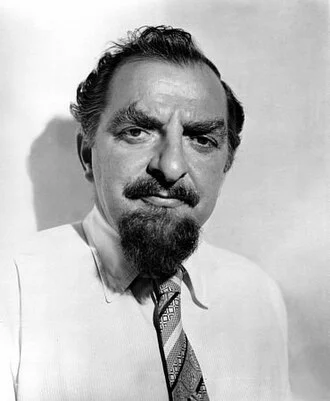
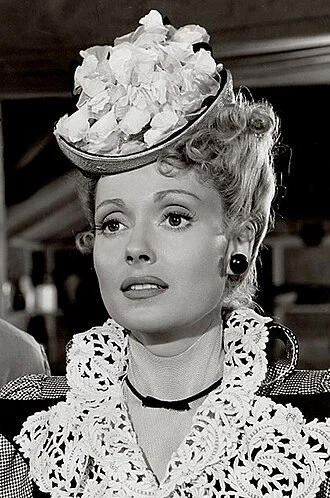

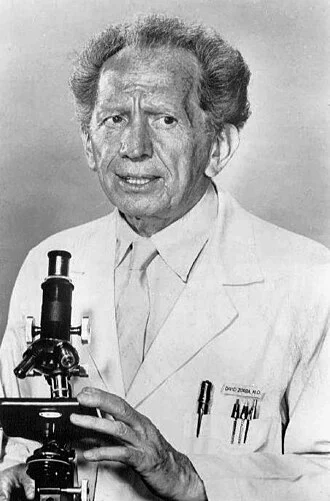
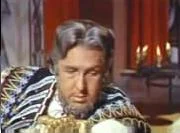
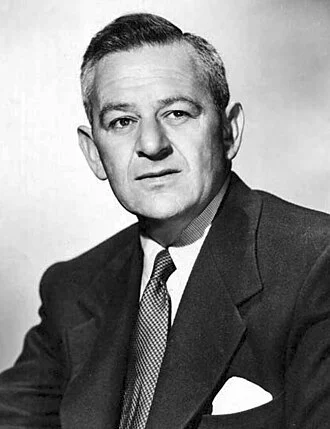
Cast and characters
- Terence Longdon
- Drusus
- George Relph
- Tiberius Caesar
- André Morell
- Sextus
- Laurence Payne
- Joseph
- Marina Berti
- Flavia
- Richard Hale
- Gaspar
- David Davies
- Quaestor
- Ady Berber
- Malluch
Behind the film
Storyline (spoilers)
In AD 26 Jerusalem, Judah Ben-Hur, a wealthy Jewish prince and merchant, lives with his mother, Miriam, and younger sister, Tirzah. The family's steward, Simonides, has a daughter named Esther who was born a slave and whom Judah has not seen since they were children. Judah grants Simonides' request to allow Esther to marry a freeman and also grants Esther her freedom as a wedding gift, although he and Esther now fall in love with each other.
Development
Lew Wallace's 1880 novel, Ben-Hur: A Tale of the Christ, ran to about 550 pages. Zimbalist hired a number of screenwriters to cut the story down and turn the novel into a script. According to Gore Vidal, more than 12 versions of the script had been written by various writers by the spring of 1958. Vidal himself had been asked to write a version of the script in 1957, refused, and been placed on suspension for his decision. According to Wyler, Vidal, their biographers (see bibliography below) and the sources that follow them, Zimbalist was unhappy with Tunberg's script, considering it to be "pedestrian"
Filming
The chariot scene took five weeks (spread over three months) to film at a total cost of $1 million Seven thousand extras were hired to cheer in the stands. Economic conditions in Italy were poor at the time, and as shooting for the chariot scene wound down, only 1,500 extras were needed on any given day. On June 6, 1958, more than 3,000 people seeking work were turned away. The crowd rioted, throwing stones and assaulting the set's gates until police arrived and dispersed them. Dynamite charges were used to show the chariot wheels and axles splintering from the effects of Messala's barbed-wheel attacks.
Box office
During its initial release, the film earned $33.6 million in North American theater rentals (the distributor's share of the box office), generating approximately $74.7 million in box-office sales. It was number one at the monthly US box office for six months. Outside of North America, it earned $32.5 million in rentals (about $72.2 million at the box office) for a worldwide total of $66.1 million in rental earnings, roughly equivalent to $146.9 million in box-office receipts. It was the fastest-grossing film in the process becoming the second-highest-grossing film of all-time (at that time) behind Gone with the Wind. It was the highest-grossing film in Japan at the time, earning $2,722,000. Ben-Hur saved MGM from financial disaster, making a profit of $20,409,000 on its initial release, and another $10.1 million in profits when re-released in 1969.
Awards
# Best Picture – Sam Zimbalist (posthumous award)
Directed by
Cast
Title details
- Release year
- 1959
- Runtime
- 212 min
- Based on
- Ben-Hur: A Tale of the Christ
- Distributors
- Loews Cineplex Entertainment, Netflix
- Content rating
- G
- Genres
- Drama
Awards and nominations
Awards received (12)
- Academy Award for Best Actor
- Academy Award for Best Art Direction, Color
- Academy Award for Best Cinematography, Color
- Academy Award for Best Costume Design, Color
- Academy Award for Best Director
- Academy Award for Best Film Editing
- Academy Award for Best Original Dramatic or Comedy Score
- Academy Award for Best Picture
- Academy Award for Best Sound
- Academy Award for Best Special Effects
- Academy Award for Best Supporting Actor
- National Board of Review: Top Ten Films
Nominations (12)
- Academy Award for Best Actor
- Academy Award for Best Art Direction, Color
- Academy Award for Best Cinematography, Color
- Academy Award for Best Costume Design, Color
- Academy Award for Best Director
- Academy Award for Best Film Editing
- Academy Award for Best Original Dramatic or Comedy Score
- Academy Award for Best Picture
- Academy Award for Best Sound
- Academy Award for Best Special Effects
- Academy Award for Best Supporting Actor
- Academy Award for Best Writing, Adapted Screenplay