Overview
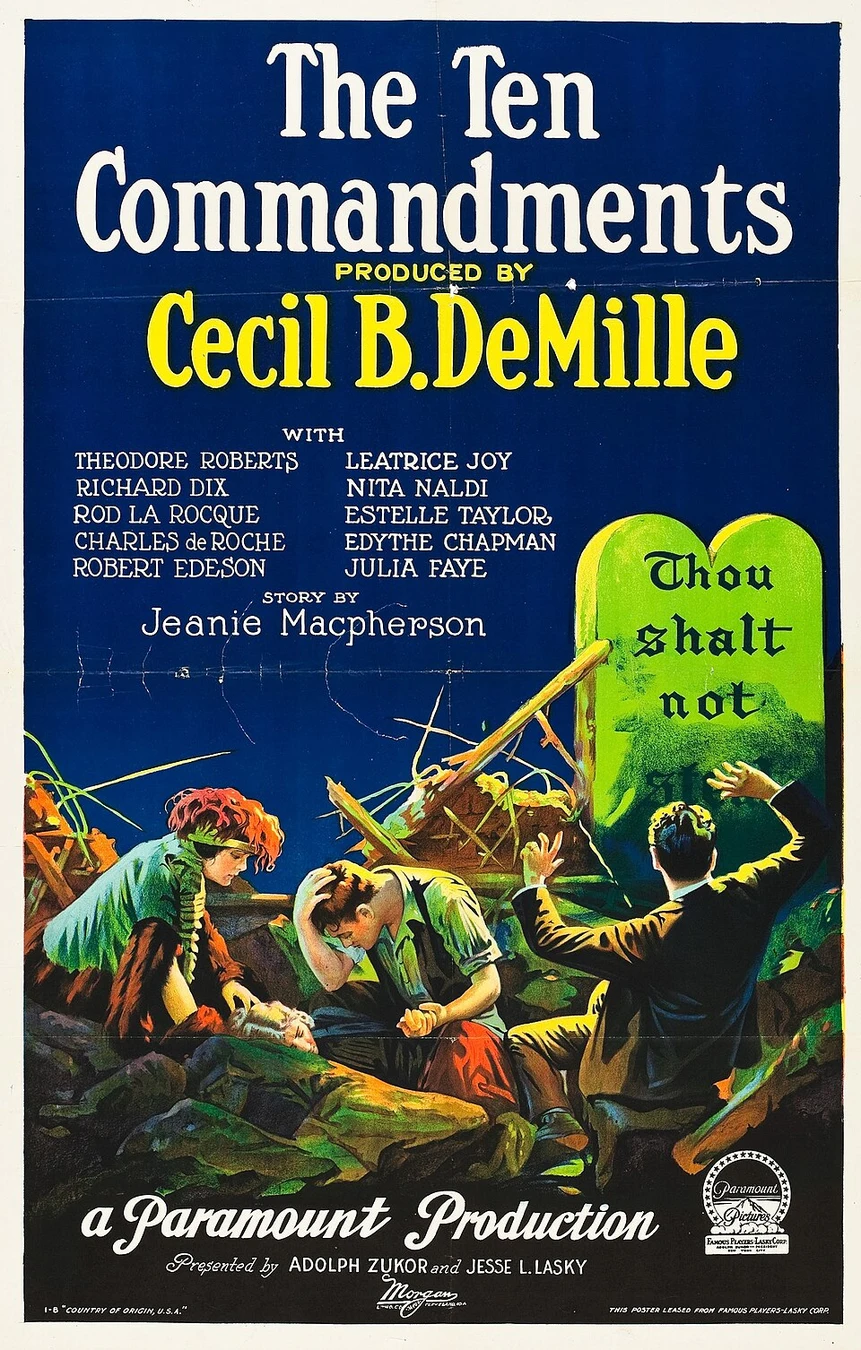
The Ten Commandments is a 1923 American silent religious epic film produced and directed by Cecil B. DeMille. Written by Jeanie MacPherson, the film is divided into two parts: a prologue recreating the biblical story of the Exodus and a modern story concerning two brothers and their respective views of the Ten Commandments. Lauded for its "immense and stupendous" scenes, use of Technicolor process 2, and parting of the Red Sea sequence, the expensive film proved to be a box-office hit upon release. It grossed $4.2 million on a $1.5 million budget. It is the first in DeMille's biblical trilogy, followed by The King of Kings (1927) and The Sign of the Cross (1932). DeMille later directed a sound remake of the film in 1956, which focuses solely on the Exodus scenes. The Ten Commandments is one of many works from 1923 that entered the public domain in the United States in 2019.
From Wikipedia contributors · CC BY-SACast and characters
- Theodore Roberts
- Moses
- Charles De Roche
- Rameses
- Estelle Taylor
- Miriam
- Julia Faye
- The Wife of Pharaoh
- James Neill
- Aaron
- Lawson Butt
- Dathan
- Clarence Burton
- The Taskmaster
- Noble Johnson
- The Bronze Man
- Richard Dix
- John McTavish
- Rod La Rocque
- Dan McTavish
- Leatrice Joy
- Mary Leigh
- Nita Naldi
- Sally Lung
- Robert Edeson
- Redding
- Charles Ogle
- The Doctor
- Agnes Ayres
- The Outcast
Behind the film
Storyline (spoilers)
The film has two parts: the Prologue, the epic tale of Moses; and the Story, in a modern setting and involving living by the Ten Commandments.
Development
In 1922, while he was still filming Adam's Rib, Cecil B. DeMille decided to let the public choose the subject of his next production. He did this because he made his films "for people rather than for critics". Instructed by DeMille, his publicist Barrett Kiesling arranged a contest with The Los Angeles Times in which the person who submitted the best idea for a film would receive $1,000, with prizes for runners-up totaling another $1,000. Because this was the first time a filmmaker asked the public for ideas, other newspapers published stories about the contest and thousands of letters eventually came in from many parts of the world. DeMille found that a number of contestants had submitted ideas for a religious theme, and there was one that he kept thinking about due to its "subject matter and power of expression". The first prize went to a lubricant manufacturer named F. C.
Filming
Production on the film started on May 21, 1923, and ended on August 16, 1923. Rumor had it that after the filming was complete, the massive sets – which included four Pharaoh statues, 21 sphinxes, and gates reaching a height of 110 feet, which were built by a small army of 1,600 workers – were dynamited and buried in the sand. Instead, the wind, rain and sand at the Guadalupe-Nipomo Dunes likely collapsed and buried a large part of the set under the ever-shifting dunes. The statues and sphinxes are in roughly the same place they were during filming. In 2012, archaeologists uncovered the head of one of the prop sphinxes; a 2014 recovery effort showed the body of that sphinx to have deteriorated significantly, but a second better-preserved sphinx was discovered and excavated.
Box office
The Ten Commandments became the highest-grossing film of 1923. The film's box-office returns held the Paramount revenue record for 25 years until it was broken by other DeMille films. The film competed at the box office with Fox's The Shepherd King, and won out overall.
Directed by
Cast
Title details
- Release year
- 1923
- Runtime
- 146 min
- Distributors
- Netflix, Paramount Pictures
- Genres
- Silent