Overview
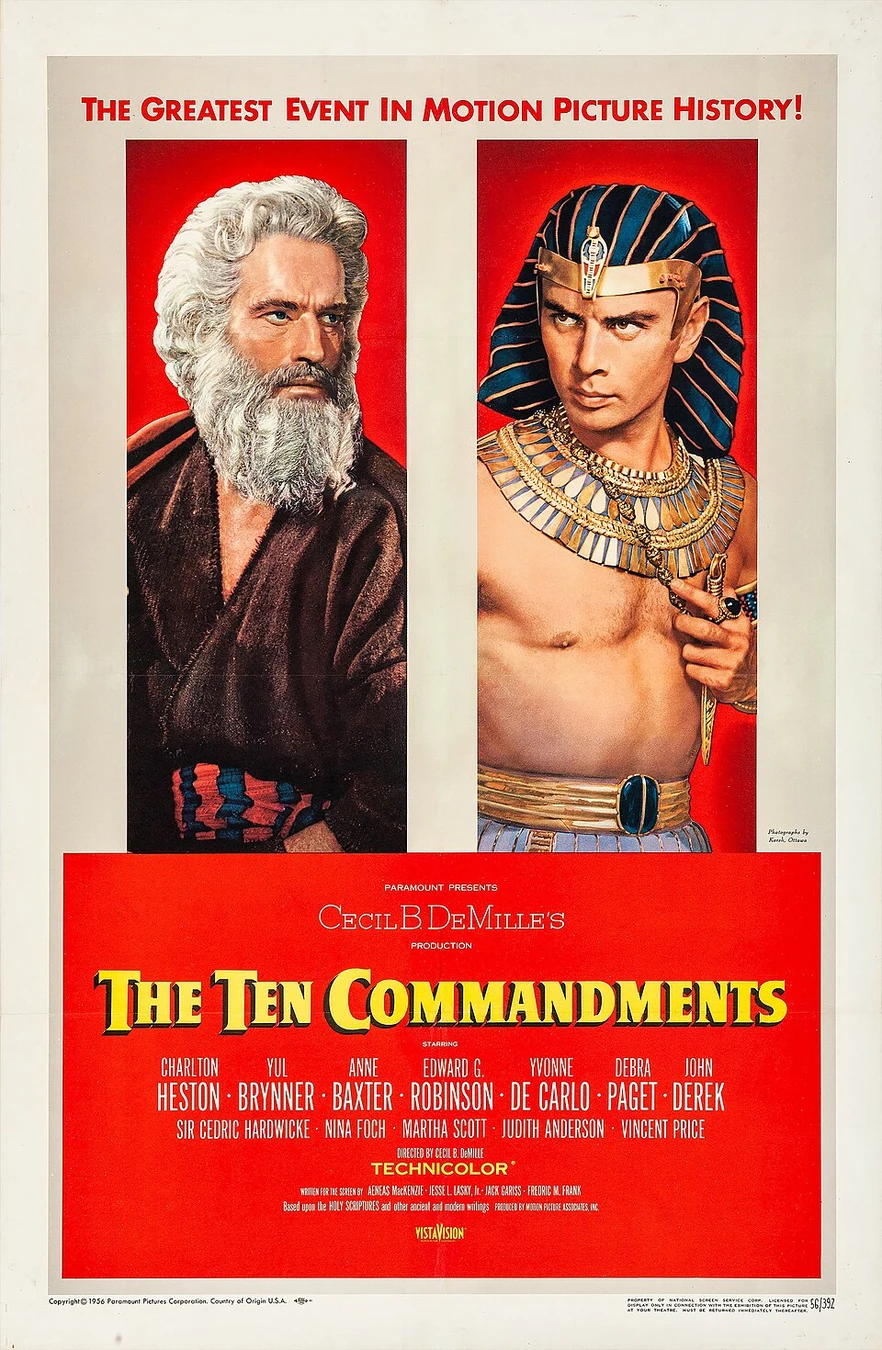
The Ten Commandments is a 1956 American biblical epic film produced, directed, and narrated by Cecil B. DeMille, shot in VistaVision (color by Technicolor), and released by Paramount Pictures. Based on the Bible's Book of Exodus and other sources, it dramatizes the story of the life of Moses, an adopted Egyptian prince who becomes the deliverer of his real brethren, the enslaved Hebrews, and thereafter leads the Exodus to Mount Sinai, where he receives the titular commandments from God. The film stars Charlton Heston in the lead role, Yul Brynner as Rameses, Anne Baxter as Nefretiri, Edward G. Robinson as Dathan, Yvonne De Carlo as Sephora, Debra Paget as Lilia, and John Derek as Joshua; and features Sir Cedric Hardwicke as Sethi I, Nina Foch as Bithiah, Martha Scott as Yochabel, Judith Anderson as Memnet, and Vincent Price as Baka, among others. First announced in 1952, The Ten Commandments is a remake of the prologue of DeMille's 1923 silent film of the same title. Four screenwriters, three art directors, and five costume designers worked on the film. In 1954, it was filmed on location in Egypt, Mount Sinai, and the Sinai Peninsula, featuring one of the largest exterior sets ever created for a motion picture. In 1955, the interior sets were constructed on Paramount's Hollywood soundstages. The original roadshow version included an onscreen introduction by DeMille and was released to cinemas in the United States on November 8, 1956, and, at the time of its release, was the most expensive film ever made. It was DeMille's most successful work, his first widescreen film, his fourth biblical production, and his final directorial effort before his death in 1959. In 1957, the film was nominated for seven Academy Awards, including Best Picture, winning the Academy Award for Best Visual Effects (John P. Fulton, A.S.C.). DeMille won the Foreign Language Press Film Critics Circle Award for Best Director. Charlton Heston was nominated for a Golden Globe Award for Best Performance by an Actor in a Motion Picture (Drama). Yul Brynner won the National Board of Review Award for Best Actor. Heston, Anne Baxter, and Yvonne De Carlo won Laurel Awards for Best Dramatic Actor, 5th Best Dramatic Actress, and 3rd Best Supporting Actress, respectively. It is also one of the most financially successful films ever made, grossing approximately $122.7 million at the box office during its initial release; it was the most successful film of 1956 and the second-highest-grossing film of the decade. According to Guinness World Records, in terms of theatrical exhibition, it is the eighth most successful film of all-time when the box office gross is adjusted for inflation. In 1999, the film was selected for preservation in the United States National Film Registry by the Library of Congress as being "culturally, historically, or aesthetically significant". In June 2008, the American Film Institute revealed its "Ten Top Ten"—the best ten films in ten American film genres—after polling over 1,500 people from the creative community. The film was listed as the tenth best film in the epic genre. The film has aired annually on American network television in prime time during the Passover/Easter season since 1973.
From Wikipedia contributors · CC BY-SACast
Behind the film
Storyline (spoilers)
After hearing the prophecy of a Hebrew deliverer that would free the Hebrews from Egyptian bondage, Pharaoh Rameses I of Egypt ordered the death of all newborn Hebrew males. Yochabel saves her infant son by setting him adrift in a basket on the Nile. Rameses I's recently widowed daughter Bithiah finds the basket and decides to adopt the boy by naming him Moses, even though her servant Memnet recognizes the child's Hebrew heritage.
Development
In July 1951, while he was working on his circus film The Greatest Show on Earth, producer-director Cecil B. DeMille chose Homer's Odyssey as the subject of his next epic. Several weeks later, he announced he was going to make a film about the Book of Esther, but then he changed his mind and said he was planning a new film about Helen of Troy, which he eventually canceled. For more than twenty years and especially after World War II, DeMille had received letters from people worldwide who asked him to make a new version of his 1923 silent film The Ten Commandments because the world "needs a reminder, they said, of the Law of God", which "is the essential bedrock of human freedom." DeMille talked about the idea with his staff and they initially considered producing it as a modern story with a biblical prologue, like the original film.
Filming
From New York City, DeMille sailed for Egypt on September 23, 1954. On October 6, he arrived in Cairo to make "the greatest production of my life"; the following day, he met the Prime Minister of Egypt, Colonel Gamal Abdel Nasser. DeMille had two meetings with Nasser and Abdel Hakim Amer, Egypt's Minister of War. Nasser and Amer were fans of DeMille's 1935 film The Crusades and especially of its star, Henry Wilcoxon, the associate producer of The Ten Commandments. The first day of filming was October 14. DeMille said that the journey from Cairo to Mount Sinai can be made "by motor car in one long, hard day", but he and his crew traveled with a two-car caravan in case one of the cars broke down. They made a stop in Abu Rudeis, where they camped overnight, and reached Saint Catherine's Monastery by sunset of the second day. The Greek Orthodox monks gave DeMille a blessing before he started to scout locations on Mount Sinai.
Box office
The Ten Commandments was the highest-grossing film of 1956, and the second most successful film of the decade. By April 1957, the film had earned an unprecedented $10 million from engagements at just eighty theaters, averaging about $1 million per week, with more than seven million people paying to watch it. During its initial release, it earned theater rentals (the distributor's share of the box office gross) of $31.3 million in North America, and $23.9 million from the foreign markets, for a total of $55.2 million (equating to approximately $122.7 million in ticket sales). It was hugely profitable for its era, earning a net profit of $18,500,000, against a production budget of $13.27 million (the most a film had cost up to that point).
Directed by
Title details
- Release year
- 1956
- Runtime
- 220 min
- Distributors
- Netflix, Paramount Pictures
- Content rating
- G
- Genres
- Drama
Awards and nominations
Awards received (1)
- Academy Award for Best Special Effects
Nominations (7)
- Academy Award for Best Art Direction, Color
- Academy Award for Best Cinematography, Color
- Academy Award for Best Costume Design, Color
- Academy Award for Best Film Editing
- Academy Award for Best Picture
- Academy Award for Best Sound
- Academy Award for Best Special Effects