Overview
Birdy is a 1984 American drama film based on William Wharton's 1978 novel. Directed by Alan Parker, it stars Matthew Modine and Nicolas Cage. Set in 1960s Philadelphia, Pennsylvania, the film focuses on the friendship between two teenage boys, Birdy (Modine) and Al Columbato (Cage). The story is presented in flashbacks, with a frame narrative depicting their traumatic experiences serving in the Vietnam War. Parker initially turned down an opportunity to direct, believing that the complex book could not be successfully adapted for a feature film. The project resurfaced in 1982 when A&M Films, a subsidiary of A&M Records, acquired the film rights and commissioned Sandy Kroopf and Jack Behr to write the screenplay. Upon reading the script, Parker returned as director, and the film continued development at Tri-Star Pictures. Principal photography began in May 1984 and concluded in August of that year. Filming took place on locations in Philadelphia and Santa Clara, California. The film is notable for being the first to be partially shot with the Skycam, a computer-controlled camera system created by Steadicam inventor Garrett Brown. The score was composed by Peter Gabriel. Birdy opened in limited release on December 12, 1984. It underperformed at the North American box office, grossing only $1.4 million against a budget of $12 million. The film received mostly positive reviews, and has an approval rating of 83% at Rotten Tomatoes. Birdy was chosen by the National Board of Review as one of the Top Ten Films of 1984, and won the Grand Prix Spécial du Jury prize at the 1985 Cannes Film Festival.
From Wikipedia contributors · CC BY-SACast & filmmakers
Film poster
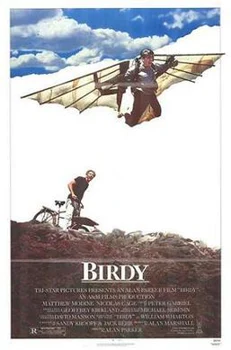
A winged figure hangs in the sky above a boy on rocky ground.
Poster source · Vybpedia article · Film publicity artworkBehind the film
Storyline (spoilers)
In a 1960s working-class neighborhood in Philadelphia, Pennsylvania, a teenage boy nicknamed "Birdy" befriends his next-door neighbor Al Columbato, who relates to Birdy’s fascination with birds and their ability to fly. The two begin pursuing Birdy's hobby of catching pigeons and caging them in a large, wooden aviary that he has built outside his parents' home.
Development
Following publication of William Wharton's 1978 novel Birdy, Alan Parker received galley proofs of the book from his agent, who advised him that the novel was going to be optioned. Upon reading the novel, Parker discussed it with his colleague, producer Alan Marshall, before turning down the opportunity to direct a film adaptation. He explained, "So much of the story happened inside the boy's head, and the poetry of the book was literary. To make it cinematic - I didn't know if I could make the jump." Kroopf and Behr made various changes from the novel, opting to focus primarily on the friendship between Birdy and Al Columbato. They also decided to set the story during the Vietnam War, as opposed to the novel, which is set during World War II. "We were in high school in the mid-1960s," Behr explained, "so growing up then was our experience." He then discussed the adaptation with executives at Tri-Star Pictures.
Awards
Birdy received several awards and honors, with particular recognition for the film itself. The National Board of Review named it one of the Top Ten Films of 1984. Following its release, the film premiered at the 1985 Cannes Film Festival, and on May 20, 1985, it won the Grand Prix Spécial du Jury prize. In 1987, the film received an Audience Award at the Warsaw International Film Festival.
Directed by
Written by
Cast
Title details
- Release year
- 1984
- Release date
- 1984-12-14
- Runtime
- 120 min
- Production companies
- Columbia Pictures
- Distributors
- Netflix, TriStar Pictures
- Genres
- Drama
- Language
- English
- Country of origin
- United States of America
- France theatrical release
- 1985-05-15
- French theatrical visa
- 60157
- Classification in France
- Tous publics avec avertissement
Awards and nominations
Awards received (2)
- Cannes Film Festival Grand Prix
- National Board of Review: Top Ten Films


 Trailer still