Overview
Blade Runner 2049 is a 2017 American science fiction thriller film directed by Denis Villeneuve from a screenplay by Hampton Fancher and Michael Green, based on a story by Fancher. A sequel to Blade Runner (1982), the film stars Ryan Gosling and Harrison Ford, with Ana de Armas, Sylvia Hoeks, Robin Wright, Mackenzie Davis, Dave Bautista, and Jared Leto in supporting roles. Ford and Edward James Olmos reprise their roles from the previous film as Rick Deckard and Gaff, respectively. Gosling plays K, a "blade runner" who uncovers a secret that threatens to destabilize society and the course of civilization. Ideas for a Blade Runner sequel were first proposed in the 1990s, but licensing issues stalled their development. Andrew Kosove and Broderick Johnson obtained the film rights from Bud Yorkin. Ridley Scott stepped down as the film's initial director and worked as an executive producer, while Villeneuve was later appointed to direct. Blade Runner 2049 was financed through a partnership between Alcon Entertainment and Sony Pictures, as well as a Hungarian government-funded tax rebate. Warner Bros., which had distributed its predecessor, released the film on behalf of Alcon in North America, while Sony handled distribution in international markets. Principal photography took place mostly at two soundstages in Budapest over four months from July to November 2016. Blade Runner 2049 premiered at the Dolby Theatre in Los Angeles, California on October 3, 2017, and was released in the United States on October 6. The film received acclaim from critics, who praised multiple aspects including cast performances, directing, cinematography, and faithfulness to the previous film. However, it was a box office disappointment, grossing $287.3 million worldwide against a production budget of $150–185 million and failing to reach its estimated break-even point of $400 million. Among its numerous accolades, Blade Runner 2049 received Academy Awards for Best Cinematography and Best Visual Effects out of five nominations, and eight British Academy Film Awards nominations, winning for Best Cinematography and Best Special Visual Effects.
From Wikipedia contributors · CC BY-SACast & filmmakers













Film poster
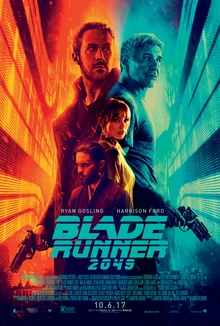
Hot orange and electric blue divide the portraits and cityscape. Gun barrels and architectural lines point into the seam between worlds.
Poster source · Vybpedia article · Film publicity artworkBehind the film
Storyline (spoilers)
In 2049 Los Angeles, bioengineered humans known as replicants are still used for slave labor. K (short for serial number, KD6-3.7), a Nexus-9 replicant, works for the Los Angeles Police Department as a "blade runner," an officer who hunts and "retires" (kills) rogue replicant models.
Development
From the 1990s, licensing disputes over Philip K. Dick's novel Do Androids Dream of Electric Sheep? (1968) had deterred the creation of sequels to the science fiction drama Blade Runner (1982). Director Ridley Scott conceived two ultimately unrealized projects vaguely connected to the Blade Runner canon in the interim, such as a stand-alone sequel titled Metropolis. Scott's second project, a collaboration with his son Luke and younger brother Tony titled Purefold, had been imagined as an episodic webseries examining conceptions of empathy.
Filming
The filmmakers embarked on location scouting in April 2016, and principal photography of Blade Runner 2049 commenced that July, lasting four months until November. They first toured London but found no soundstage available for the needs of the production. As a result, Deakins and Villeneuve flew to Hungary for location scouting partly due to Scott's familiarity with the country's network of facilities. They also toured Slovakia to source architectural ideas. Blade Runner 2049 production crew were mostly Hungarian, with some American staff hired to supervise the set. where the shoot qualified for a 25% tax rebate on in-state costs from the Hungarian government.
Box office
Blade Runner 2049 grossed $92.1million in the United States and Canada, and $175.4million in other territories, for a worldwide total of $267.5million, against a production budget between $150–185million. Ridley Scott attributed the film's underperformance to the runtime, saying: "It's slow. Long. Too long. I would have taken out half an hour."
Awards
Blade Runner 2049 received numerous awards and nominations. At the 90th Academy Awards, it was nominated for five awards, winning Best Cinematography for Deakins, and Best Visual Effects for John Nelson, Gerd Nefzer, Paul Lambert, and Richard R. Hoover. At the 71st British Academy Film Awards, it received eight nominations, including Best Director, and won for Best Cinematography and Best Special Visual Effects. At the 23rd Critics' Choice Awards, the film was nominated for seven awards, winning for Best Cinematography.
Directed by
Written by
Cast
Title details
- Release year
- 2017
- Runtime
- 163 min
- Production companies
- Alcon Entertainment, Columbia Pictures, Scott Free Productions, Thunderbird Entertainment, Warner Bros. Entertainment
- Distributors
- InterCom, Netflix, Sony Pictures Releasing, Sony Pictures Releasing France, Warner Bros. Entertainment
- Content rating
- R
- Genres
- Noir, Science Fiction
- Language
- English
- Country of origin
- Canada, United Kingdom, United States
- France theatrical release
- 2017-10-04
- French theatrical visa
- 146469
- Classification in France
- Tous publics avec avertissement
- Netflix reported views
- 1,400,000 · Blade Runner 2049 · 2026 H1
- Title in Brazil
- Blade Runner 2049
- Brazil theatrical release
- 2017-10-05
- Brazilian film certificate
- E1700363300000
- Distributor in Brazil
- Sony
Awards and nominations
Awards received (3)
- Academy Award for Best Cinematography
- Academy Award for Best Visual Effects
- Saturn Award for Best Science Fiction Film
Nominations (5)
- Academy Award for Best Cinematography
- Academy Award for Best Production Design
- Academy Award for Best Sound
- Academy Award for Best Sound Editing
- Academy Award for Best Visual Effects