Overview
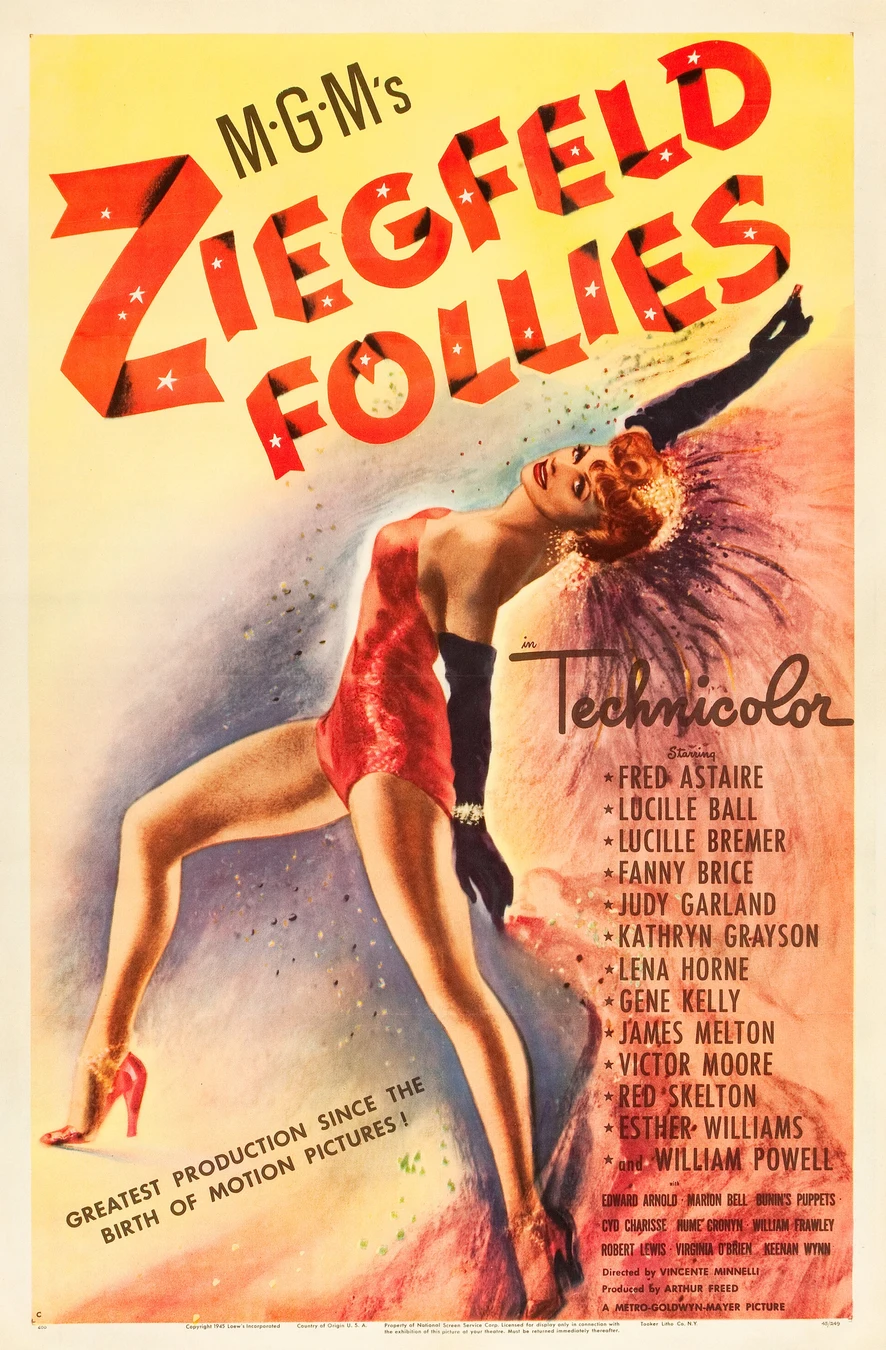
Ziegfeld Follies is a 1945 American musical comedy film released by Metro-Goldwyn-Mayer (MGM), primarily directed by Vincente Minnelli, with segments directed by Lemuel Ayers, Roy Del Ruth, Robert Lewis, and George Sidney, the film's original director before Minnelli took over. Other directors that are said to have made uncredited contributions to the film are Merrill Pye, Norman Taurog, and Charles Walters. It stars many MGM leading talents, including Fred Astaire, Lucille Ball, Lucille Bremer, Fanny Brice (the only member of the ensemble who was a star of the original Follies), Judy Garland, Kathryn Grayson, Lena Horne, Gene Kelly, James Melton, Victor Moore, William Powell, Red Skelton, and Esther Williams. Producer Arthur Freed wanted to create a film along the lines of the Ziegfeld Follies Broadway shows, and so the film is composed of a sequence of unrelated lavish musical numbers and comedy sketches. Some of them, such as Pay the Two Dollars, originated in George White's Scandals. Filmed in 1944 and 1945, it was released in 1946 to considerable critical and box-office success. The film was entered into the 1947 Cannes Film Festival.
From Wikipedia contributors · CC BY-SACast and characters
- William Powell
- Florenz Ziegfeld Jr
- Fred Astaire
- himself
- Lucille Ball
- herself in “Here’s to the Ladies”
- Cyd Charisse
- Ballerina in “Here’s to the Ladies”
- Virginia O'Brien
- herself singing “Bring on Those Wonderful Men”
- Esther Williams
- herself in “ A Water Ballet”
- Keenan Wynn
- the caller in “Number Please”
- James Melton
- Alfredo in “Traviata”—Singing Libiamo ne' lieti calici
- Marion Bell
- Violetta in “Traviata”—Singing Libiamo ne' lieti calici
- Victor Moore
- Lawyer's Client in "Pay the Two Dollars"
- Edward Arnold
- Lawyer in "Pay the Two Dollars"
- Fred Astaire
- a jewel thief
- Lucille Bremer
- lovely aristocrat in “This Heart of Mine”
- Fanny Brice
- Norma Edelman in "A Sweepstakes Ticket"
- Hume Cronyn
- Monty Edelman in "A Sweepstakes Ticket"
- Fred Astaire
- man in black in “A dramatic pantomime
- Lucille Bremer
- the woman in yellow in “A dramatic pantomime
Behind the film
Storyline (spoilers)
After a long Overture, the movie opens with the camera panning over a Heaven somewhere beyond the clouds. The residences of great showmen gone to their eternal reward are shown: Shakespeare, whose home looks like the Globe Theater; P.T.Barnum, whose residence in the afterlife resembles a circus Big Top; and Florenz Ziegfeld, whose home's entrance is reminiscent of the theater where he staged the Ziegfeld Follies on Broadway.
Box office
According to MGM records, the film earned $3,569,000 in the US and Canada, and $1,775,000 elsewhere - but because of its enormous cost, it incurred a loss to the studio of $269,000.
Awards
1947 Cannes Film Festival Best Musical Comedy (Prix de la meilleure comédie musicale) Won
Directed by
Cast
Title details
- Release year
- 1945
- Runtime
- 110 min
- Based on
- Ziegfeld Follies
- Distributors
- Metro-Goldwyn-Mayer, Netflix
- Genres
- Musical, Comedy