Overview
Fritz the Cat is a 1972 American Independent adult animated black comedy film written and directed by Ralph Bakshi in his directorial debut. Based on Robert Crumb's comic strip of the same name, the film focuses on its Skip Hinnant–portrayed titular character, a glib, womanizing and fraudulent cat in an anthropomorphic animal version of New York City during the mid-to-late 1960s. Fritz decides on a whim to drop out of college, interacts with inner city African American crows, unintentionally starts a race riot and becomes a leftist revolutionary. The film is a satire focusing on American college life of the era, race relations, and the free love movement, as well as serving as a criticism of the countercultural political revolution and dishonest political activists. Fritz the Cat had a troubled production history, with Crumb disagreeing with the filmmakers over the film's artistic direction. Produced on a budget of $700,000, the film was intended by Bakshi to broaden the animation market. At that time, animation was primarily viewed as a children's medium. Bakshi envisioned animation as a medium that could tell more dramatic or satirical storylines with larger scopes, dealing with more mature and diverse themes that would resonate with adults. Fritz the Cat's depiction of profanity, extreme violence, sex, nudity, anti-religious humor, smoking, drinking and drug use, particularly cannabis, provoked criticism from more conservative and nationalist members of the animation industry, who accused Bakshi of attempting to produce a pornographic animated film, as the concept of adult animation was not widely understood at the time. The Motion Picture Association of America gave the film an X rating (the predecessor of the NC-17 rating), making it the first American animated film to receive the rating, which was then predominantly associated with more arthouse films. Fritz the Cat was highly successful. It grossed over $90 million worldwide, which makes it one of the most successful independent films of all time. It earned significant critical acclaim in the 1970s, for its satire, social commentary and animations, despite attracting some negative response accusing it of racial stereotyping and having an unfocused plot, and criticizing its depiction of graphic violence, profanity, sex and drug use in the context of an animated film. The film's use of satire and mature themes is seen as paving the way for future animated works for adults, including The Simpsons and South Park. A sequel, The Nine Lives of Fritz the Cat (1974), was produced without Crumb's or Bakshi's involvement.
From Wikipedia contributors · CC BY-SACast & filmmakers
Cast and characters
- Skip Hinnant
- Fritz the Cat
- Rosetta LeNoire
- Bertha / Additional voices
- John McCurry
- Duke the Crow / Bar Patron
- Phil Seuling
- Ralph / Additional voices
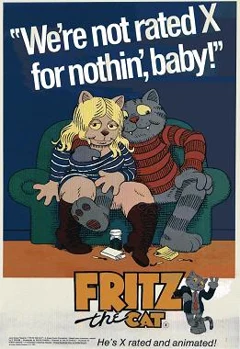
Film poster
The cartoon couple sprawls on a green couch below a conspicuously tilted quotation.
Poster source · Vybpedia article · Film publicity artworkBehind the film
Storyline (spoilers)
Set in 1960s Manhattan, a group of hippies gather at Washington Square Park to perform protest songs. Fritz, an anthropomorphic tabby cat, arrives with his friends in an attempt to impress three girls, who instead show interest in an anthropomorphic crow standing nearby. In their effort to connect, the girls make unintentionally condescending remarks about black people. After the crow rebukes the girls and leaves, Fritz then presents himself as a troubled intellectual and invites the girls to "seek the truth" with him.
Development
While browsing the East Side Book Store on St. Mark's Place, Bakshi discovered a copy of R. Crumb's Fritz the Cat (1969). Impressed by Crumb's sharp satire, Bakshi purchased the book and proposed to Krantz that it could serve as the basis for a feature film. Believing Crumb's sensibilities aligned with his own, Bakshi wanted to direct it. Krantz arranged a meeting with Crumb, during which Bakshi presented sample drawings he had made in Crumb's style, demonstrating his ability to faithfully adapt the work into animation. Impressed by Bakshi's tenacity, Crumb lent him one of his sketchbooks for reference.
Directed by
Written by
Cast
Title details
- Release year
- 1972
- Release date
- 1972-04-12
- Runtime
- 75 min
- Based on
- Fritz the Cat
- Distributors
- Cinemation Industries
- Content rating
- X
- Genres
- Comedy, Animated, Independent, Erotic
- Language
- English
- Country of origin
- United States of America


 Trailer still